Source – stuartbramhall.wordpress.com
– “…Lloyd Blankfein, he of Goldman Sachs fame, proclaims he is “doing God’s work”. This one was my favourite: “There are two things that are important in politics. The first is money, and I can’t remember what the second is.” The statement comes from Mark Hanna, a Republican of the late 19th century, who bankrolled the presidential campaign of William McKinley”
The Unasked Question “How many more billionaires can civilization sustain before it collapses?” – By Brian Lynch
The New York Times recently asked each of the Democratic primary candidates for President a series of identical questions. The last question on their list was, “Does anyone deserve to have a billion dollars?”

ABOVE: The Democrat party mob for 2020. Many are there simply to dilute Sanders, who needs no help in diluting himself. “Important questions about wealth inequality and its impact on the environment are not being asked to the Presidential Candidates“
The trivial framing of that question bypassed the grave urgency for asking it in the first place. In a variant form of the question the Times was essentially asking, “Isn’t it OK to be a billionaire if you played by the rules and worked hard to earn it?”
The wording of the question pre-supposes that the laws and social rules in place, by which a person may accumulate a billion-dollars, are fair and open to anyone. It ignores whether inherited wealth is also deserved. Most importantly, it treats wealth as if it is only a money count and not a measure of privilege and social power. By doing so, the question as it was posed ignored the essential problem that extreme private wealth is toxic to human society regardless of a person’s character or how they obtained it.
A more salient question would have been, “How many more billionaires can this human society sustain before it collapses?
In the 50,000-year history of human civilization, the concepts of private ownership and private wealth are recent developments. The full ramifications of these constructs on our social cohesion and collective welfare are still being revealed. The written history of civilizations offers no comfort. There are no examples of a happy, stable society where extremes of wealth inequality existed. The lessons of history seem to be that a suitable balance of power is required to sustain a healthy and stable society. Human populations simply cannot tolerate distributions of wealth/power that either force unnatural equality or permit unlimited extremes of private wealth.
There is no question that we crossed the Rubicon into a world where extreme wealth inequality is corrupting world governments and destroying the balance of nature. The questions we should be asking candidates for President and all our elected officials are, “What are your plans to rebalance the distribution of wealth and social power in America?” And then the follow-up question, “What are you going to do to stabilize and rebalance the Earth’s damaged ecology?”
Related…
The Trouble With Billionaires by Linda McQuaig and Neil Brooks – Review
An entertaining account of the problems caused by inequality of wealth leaves some important questions unanswered
The Trouble With Billionaires by Linda McQuaig and Neil Brooks – Review
An entertaining account of the problems caused by inequality of wealth leaves some important questions unanswered
“Casse-toi riche con!” (Get lost, rich jerk). So declared the front-page headline in the newspaper Libération when Bernard Arnault, France’s richest man, said he was leaving for Belgium in protest at a 75% tax rate. Arnault’s example was followed by the absurd Gérard Depardieu. Unlike the actor, however, the business tycoon, who runs the LVMH luxury goods group, finally withdrew his threat.
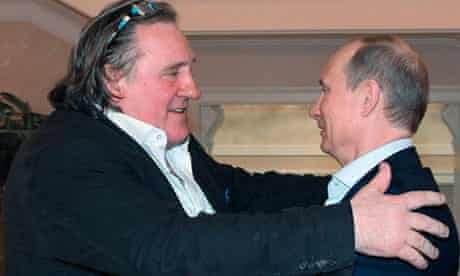
Gérard Depardieu ran to Vladimir Putin to get Russian citizenship and avoid a French tax on the super-rich. Photograph: Mikhail Klimentyev/AP
This episode is one of the many entertaining and enraging examples in a new exposé of the super-rich. Linda McQuaig and Neil Brooks focus their ire on income levels and tax. Between 1980 and 2008, during the time of supposed plenty, the income of the bottom 90% of Americans grew by a measly 1%. The income of the top 0.01% grew by 403%.

Their polemic is assiduously researched and a fast-paced read. They leaven graphs and data with amusing quotes from a rogue’s gallery of the rich. Lloyd Blankfein, he of Goldman Sachs fame, proclaims he is “doing God’s work”. This one was my favourite: “There are two things that are important in politics. The first is money, and I can’t remember what the second is.” The statement comes from Mark Hanna, a Republican of the late 19th century, who bankrolled the presidential campaign of William McKinley.
The period 1940-80 was the most egalitarian era in modern western history. Thanks to progressive taxes, the share of national income in the UK held by the top 1% dropped from 17% on the eve of the second world war to 6% pre-Maggie. This, the authors argue, was an era of more fairness and almost unprecedented prosperity – for the many. This is the nub of their argument – a correlation between high tax levels and better social outcomes.
The book argues passionately against the present austerity of the coalition government. Yet why is there so little public anger on the streets in Britain? The authors ask the question but don’t come up with an answer. More worryingly, why do polls suggest greater animosity towards welfare “scroungers” than bankers? Rather than have my preconceptions confirmed, I would appreciate even more a book that deconstructs the obedient relationship the “ordinary” person has towards the oligarchy.
https://www.theguardian.com/books/2013/jun/30/trouble-with-billionaires-mcquaig-review


 RIELPOLITIK