Source – exemplore.com
– “…According to legend, the medieval manuscript was made out of a pact with the ‘devil’, which is why it is sometimes referred to as the Devil’s Bible. The story behind the making of Codex Gigas (“the giant codex”) is that it was the work of one monk who was sentenced to death by being walled up alive”:
(The Legend of Codex Gigas or “The Devil’s Bible”)
The pages are allegedly made from the skins of 160 donkeys, the Codex Gigas, is the world’s largest and the most mysterious medieval manuscript. According to the Codex legend, this disturbingly beautiful text sprang from a pact made between a doomed monk, and the devil.
This thirteenth century old manuscript was written by a Benedictine monk in what is now the Czech Republic. The Codex Gigas (Latin for “Giant Book”) is interesting in its own right for being the largest existing medieval text in the world. But it is the less than holy legend behind the Codex Gigas that draws most of the attention. Created in the early 13th century in the Benedictine monastery of Podlažice in Bohemia, the Codex Gigas is now under the watchful eye of the National Library of Sweden in Stockholm. The text is so large that two librarians are needed to lift it.
According to the Codex legend, the single scribe was a monk who breached his monastic code and was sentenced to be walled up alive with no chance of escape. There was only one way the monk could avoid his excruciating death, he promised to create a beautiful, and fascinating book to glorify the monastery forever; a book that would include all human knowledge. There was one catch, he was given only twenty-four hours to complete the task in and if the monk would complete the task, then be free to live.
The monk began to compose a bible written on animal skins, with colored inks and illustrations; completely illuminated (means decorated initials and miniature border artwork) in the manuscript style made back during that era. Legend has it that near midnight the monk became sure that he could not complete this task alone, so he sold his soul to the devil for help. The devil completed the manuscript and the monk added the devil’s picture out of gratitude for his help. It is because of this unique illustration that it the Codex Gigas is also known as the Devil’s Bible.
The Codex Gigas measures 36 1/4 inches by 19 3/4 inches and is 8 inches thick. There are a total of 320 pages, but many of the pages have been torn out; most likely because they contained the Benedictine secrets. On page 290 of “The Devil’s Bible” is a full page illustration of the devil. On the opposite page is an illustration of what heaven might look like. There is no recorded proof of the Codex legend, but the unusual text has an aura-like quality all its own, even though it is very old and has passed through a number of hands through the centuries.
Click thumbnail to view full-size

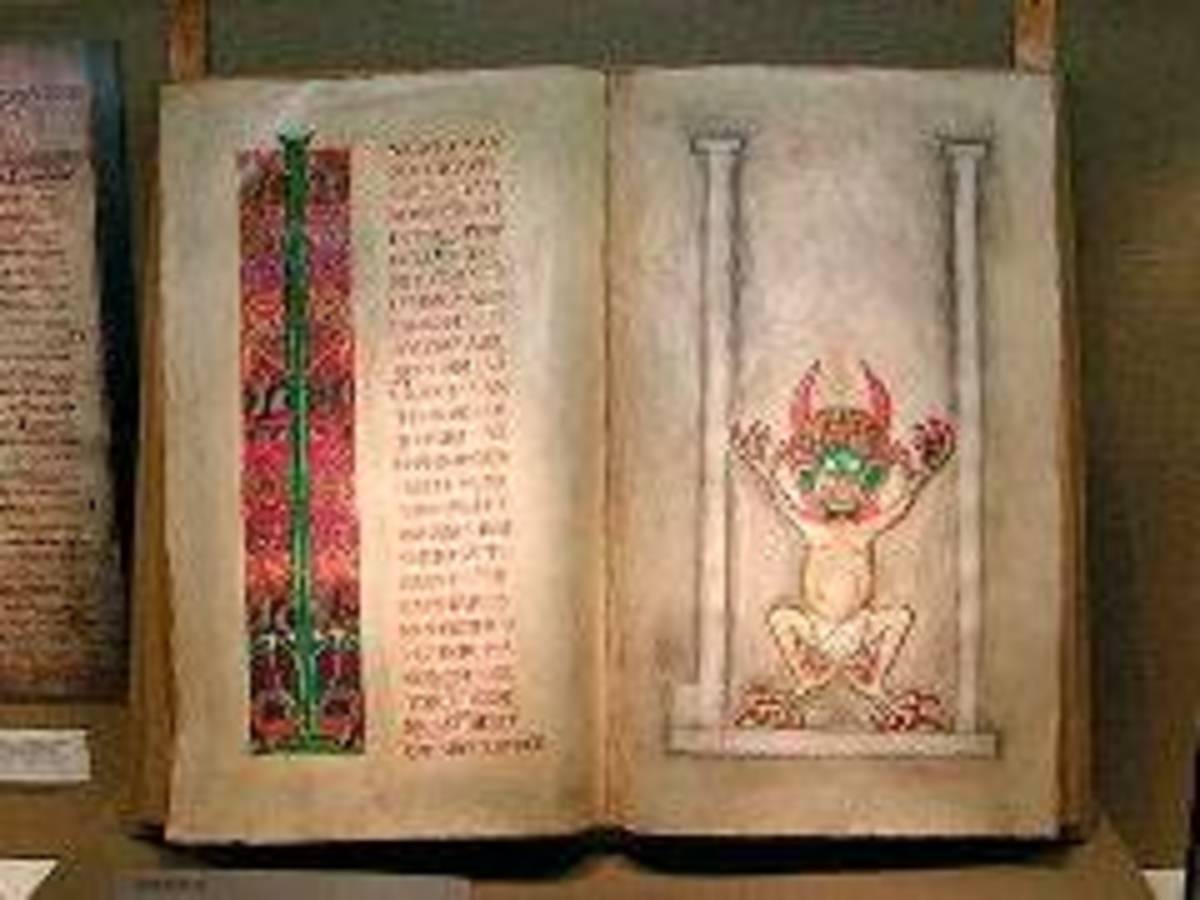


“The Devil’s Bible”
Once, the Codex Gigas was the eighth wonder of the world; the book weighs a hundred and sixty-five pounds. And unlike the above legend section that states the Codex is written on the skins of donkeys… it is actually made from calf skins. The Codex Gigas texts include pages not found anywhere else, inside the pages is a full Latin bible, passages in the book contain herbals, history books, cures for dangerous illnesses, texts regarding caring for the soul, medical formulas for treating illnesses and diseases, spells, and even solutions to problems (such as finding a thief).
The Influence Of The Codex Gigas
The Codex Gigas surfaced when the Benedictine monastery in Podlacize, Bohemia became financially troubled. To raise money, the monks sold the manuscript to a monastery near Prague. Soon after the text was in its new home, that monastery also failed. A few years later the Holy Roman Emperor, Rudolf became obsessed with the Codex, as well as, other alchemy and scripts written on the occult. Not too soon after,the monk gave the Codex to him as a gift, Emperor Rudolf became erratic and paranoid. He was declared unfit to rule and was banished by his family. During the Thirty Years War in the mid 17th century, Swedish armies seized the Codex.
Could It Have Been Written By One Man?
One of the mysteries of the Codex Gigas legend is who wrote it. Many would say that it is impossible that one man could have written the complete text alone. Yet, recently an investigation team of scholars, sponsored by National Geographic, findings support the story that the Codex is the work of one man.
What The Experts Found
During the study, of the manuscript’s text, invetigators noted that the book uses only one type of ink; which was made from crushed insect nests. The style and font of the calligraphy is consistent throughout, leading the investigators to believe that the manuscript is the work of one scribe rather than many. The text’s lettering is believed to be self-taught, because of the lack of sophistication. The team also felt that the scribe must have been gifted, even though he was an amateur; because of the devil’s portrait. The experts estimate that “The Devil’s Bible” would have taken a minimum of 25-30 years to complete.
The Meaning Of Devil’s Image
It obvious now, how the text got its nickname. It is the only bible to have a large image of the devil. A devil that is pictured half-clothed in royal ermine; he is half man, half beast; with claws, cloven hooves, and a huge snake-like red tongue. The drawing shows Satan walled up in a cell alone rather than with his subjects in Hell. The page directly across from the devil’s image is a portrait of the Kingdom of Heaven, creating a possible message. The legend is actually based on a misinterpretation of the word “inclusus” as the punishment of being walled up alive, but which actually refers to a monk choosing to live in a solitary cell away from the others.
Codex Gigas – Devil’s Bible
Click thumbnail to view full-size


Codex Gigas
The codex is contained in a wooden folder, covered with leather and ornamented with metal. Records in the codex end in the year 1229. From 1477-1593 it was kept in the library of a monastery in Broumov until it was taken to Prague in 1594 and given to the Emperor Rudolf II. The manuscript includes illuminations in red, blue, yellow, green and gold. Capital letters are elaborately illuminated, frequently across the entire page. The writing inside the Codex is unified and unchanged throughout. This may have led to the belief that the whole text was written in a very short time.
Despite this legend the codex was not forbidden by the Inquisition and was studied by many scholars. It is said that this particular handwriting has not been found anywhere else. Many aspects of the legend most probably originated in truth, however due to the large portrait of Satan which would have been unique at the time, it is likely that the legend altered the truth so that the story could be retold in a more interesting way.
Anyone from the time who looked at the book would most likely be drawn to the portrait of Satan, thus getting the impression that this was one of the book’s focal points, explaining why people would believe that the monk made a pact with the devil. What many would have failed to see was that the page opposite this portrait was what is believed to be a picture of the kingdom of heaven. Now, many believe that double page spread was made to symbolize the fact that good and evil exist side-by-side, and nothing sinister. What most likely happened is that the monk requested to produce the book in solitude, probably over a period of at least twenty years.

As Atonement For One’s Sins
Over the years the manuscript has been given a variety of names alluding to its size and to the portrait of the Devil. Apart from the Devil’s Bible and Codex Gigas it has also been called Codex Giganteus (the Giant Book), Gigas librorum (the Book Giant), Fans Bibel (the Devil’s Bible), Hin Håles Bibel (‘Old Nick’s Bible’) and Svartboken (the Black Book).
Author Eugène Fahlstedt (1851-1935), interviewed in 1911, described how, some time during the 1870s, his friend August Strindberg had taken his friends to the library to read the Devil’s Bible. “It was late at night, but Strindberg, who worked at the Royal Library, had a key. He got out the Bible and struck a light with matches, and there by the light of sulphurous flames, thus … thus … (gesture of their leaning forward) … thus they read from the Devil’s Bible.”
The Devil’s Bible still retained its magical aura after the Middle Ages, when new legends still arise.
https://exemplore.com/paranormal/The-Codex-Gigas-The-Legend-Of-The-Devils-Bible
Related…
(Codex Gigas (the Devil’s Bible) – the largest manuscript in the world – By John Black)
Codex Gigas, otherwise known as ‘the Devil’s Bible’ is the largest and probably one of the strangest manuscripts in the world. It is so large that it is said to have taken more than 160 animal skins to make it and takes at least two people to lift it. It measures approximately 1 metre in length.
According to legend, the medieval manuscript was made out of a pact with the ‘devil’, which is why it is sometimes referred to as the Devil’s Bible. It was written in Latin during the 13 th century AD, and although the origin of the manuscript is unknown, a note in the manuscript states that it was pawned in the monastery at Sedlec in 1295.

The story behind the making of Codex Gigas (“the giant codex”) is that it was the work of one monk who was sentenced to death by being walled up alive. Indeed, an analysis on the text does suggest that it was written by just one scribe due to the level of uniformity throughout. The legend says that the monk produced the manuscript in just one night… with the devil’s help. However, it is not known where this legend started and it is suspected that it was religiously propagated.
Stories and legends say that the Codex Gigas brought disaster or illness on whoever possessed it during its history. Fortunately, the National Library in Stockholm, where it is currently housed, appears immune to the curse of the codex!
Codex Gigas contains a complete vulgate Latin translation of the Bible as well as five other major texts. It begins with the Old Testament and continues with ‘Antiquities of the Jews’ by Flavius Josephus (1 st century AD; ‘ Encyclopedia Etymologiae ’ by Isidore of Seville (6 th century AD); a collection of medical works of Hippocrates, Theophilus and others; the New Testament; and ‘The Chronicle of Bohemia’ by Cosmas of Prague (1050 AD).
Smaller texts are also included in the manuscript with the most famous ones including: text on exorcism, magic formulas, a picture of the Heavenly City, and a full page illustration of the Devil. The illustration is the reason why legend says the codex was written with the devil’s help.
According to the National Geographic , it would take one person working continuously, day and night, for five years to recreate the contents of Codex Gigas by hand (excluding the illustrations). Therefore, realistically it would have taken at least 25 years for the scribe to create the codex from scratch. Yet, all this time, the writing retained an incredible uniformity from start to finish. This may be the source of the legend which says that the monk wrote it in just one day.
The manuscript is currently displayed at the National Library in Stockholm where you can also view the digital pages of the Codex. Anyone in Sweden should pay a visit to the see Codex Gigas – and do not be afraid, it is quite safe to read the so-called Devil’s Bible!
Related Links
Codex Gigas – National Library of Sweden
Codex Gigas: Devil’s Bible or Just an Old books?
Related Videos
By John Black


 RIELPOLITIK