Source – medium.com
– Walk-in?: Under Hersh’s account, the walk-in provided the breakthrough intelligence that allowed the US government to begin putting together the assassination plan against bin Laden.
The evidence reviewed here shows that the US already had precise intelligence indicating bin Laden’s presence at the Abbottabad compound since 2008 at latest — yet the CIA failed to act on this information until an ISI officer walked into the US embassy and spilled the beans to CIA staff in return for a lucrative reward.
This means that neither the courier cover-story, nor the ISI walk-in, were the real sources of intelligence on bin Laden’s presence in Abbottabad. Rather, the numerous reports of his movements across Pakistan to meet leaders of various militant groups indicate that bin Laden was identifiable to multiple intelligence agencies months and years before the raid.
And there is no avoiding the fact that two months before the raid, information on bin Laden’s movements had come to the CIA via the intelligence agencies of Saudi Arabia and Pakistan — the very agencies involved in the secret operation to protect Osama bin Laden in Abbottabad.
Indeed, the US had obtained precise information on bin Laden’s movements from all its main regional allies, including Pakistan.
There are related anomalies. As national security reporter Gareth Porter points out, the retired Pakistani military officer, Brig. Gen. Qadir, found from interviews with locals in the area of bin Laden’s compound that there was no evidence whatsoever of the compound being guarded by the ISI, in a manner consistent with Hersh’s account of bin Laden being held captive. Security forces were nowhere to be seen guarding the complex.
In fact, during the course of his investigation, Qadir had also come across the same ‘walk-in’ story. But Qadir discounted it for being implausible in the fraught climate of Pakistan’s intelligence world.
“Qadir had picked up the walk-in story,” relates Porter, “complete with the detail that the Pakistani in question was a retired ISI officer who had been resettled from Pakistan — from American contacts in 2011.” In his book, the Brigadier General writes: “There is no way a Pakistani Brigadier, albeit retired, could receive this kind of money and disappear.” For such a betrayal, the ISI’s retaliation would be ruthless and immediate.
This suggests that the walk-in played a different role to that assumed by Hersh and his sources: rather than being instrumental in identifying bin Laden’s location, the walk-in was simply instrumental in triggering the events leading to his assassination: he blew the whistle on a highly compartmentalised intelligence operation, bringing bin Laden’s presence in the heart of Pakistan’s military intelligence community to the attention of disbelieving CIA staff in August 2010, and forcing the wider US intelligence community to take action.
Intelligence asset
Several compelling accounts confirm that bin Laden’s presence at the Abbottabad compound was sanctioned at the highest levels of Pakistani military intelligence. In the New York Times, Carlotta Gall reports that the “handling” of Osama bin Laden himself was a closely-guarded ISI operation, and that bin Laden himself was an ISI asset.
“According to one inside source, the ISI actually ran a special desk assigned to handle Bin Laden,” reports Gall.
“I learned from a high-level member of the Pakistani intelligence service that the ISI had been hiding Bin Laden and ran a desk specifically to handle him as an intelligence asset… It was operated independently, led by an officer who made his own decisions and did not report to a superior. He handled only one person: Bin Laden. I was sitting at an outdoor cafe when I learned this, and I remember gasping, though quietly so as not to draw attention. (Two former senior American officials later told me that the information was consistent with their own conclusions.) This was what Afghans knew, and Taliban fighters had told me, but finally someone on the inside was admitting it. The desk was wholly deniable by virtually everyone at the ISI — such is how supersecret intelligence units operate — but the top military bosses knew about it, I was told.”
This is possible due to layers of careful compartmentalisation, not just between the ISI and other government agencies, but also within the ISI itself.
“In 2007, a former senior intelligence official who worked on tracking members of al-Qaeda after Sept. 11 told me that while one part of the ISI was engaged in hunting down militants, another part continued to work with them.”
It is therefore not surprising that other ISI officials, although they knew that a raid was occurring, had no idea that the target was bin Laden. “They gave us a grid and told us that they were going there after ‘a high-value’ target. There are certain protocols when that happens — we take care of the outer security, while they go in and do their work. We certainly didn’t know who exactly was in there.” The same official, like US Army special operations veteran Jack Murphy, dismissed claims that the US had jammed Pakistani radars.
But certain senior ISI officials were involved. Corroborating Hersh’s account, in a report for Asia Times from 12th May 2011, Syed Saleem Shahzad reported that “Pakistan’s military and intelligence community was fully aware of and lent assistance to the United States mission to get a high-value target in Abbottabad.” But Shahzad’s sources also told him: “What it did not know was that it was Osama bin Laden who was in the crosshairs of US Special Forces.”
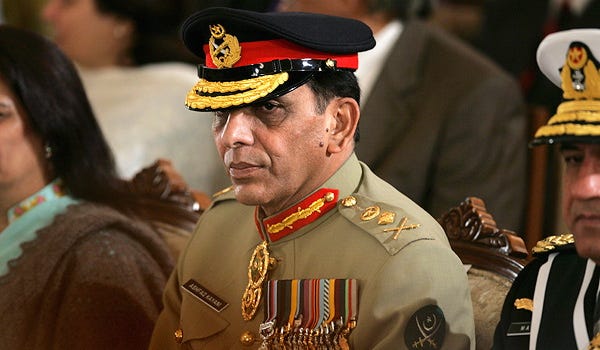
In reality, Shahzad’s sources did not know, but according to Hersh’s and Murphy’s sources, two Pakistani Generals did know bin Laden was the target. And Hersh’s sources specifically identified the officials as Pakistani Army chief Ashfaq Kayani and ISI Director-General Lieutenant Gen. Ahmad Shuja Pasha.
Shahzad’s previous report from before the raid had already put paid to the idea that bin Laden’s presence in Abbottabad was unknown to Pakistani intelligence. It showed that Saudi and Pakistani intelligence were tracking bin Laden’s meetings with militants on behalf of the CIA months before the raid — indicating that bin Laden’s presence and movements from his base in Abbottabad were known to senior ISI officials.
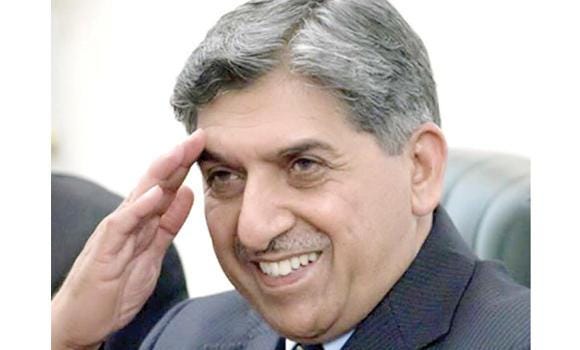
Shahzad’s May piece further corroborated Hersh’s account in reporting meetings between Pasha, Kayani, and US officials. Before the raid, he wrote, the US and Pakistan were negotiating a deal under which the US would have the unilateral right to conduct attacks on “high-value targets” like bin Laden and his deputy Dr Ayman al-Zawahiri, in return for “better economic deals” for Pakistan and “a greater role in the Afghan end game.”
To facilitate the deal, “top Saudi authorities” were called in, including “Prince Bandar bin Sultan,” to play a “pivotal role in fostering a new strategic agreement of which the Abbottabad operation was a part.”
As we shall see later, Saudi Arabia and Prince Bandar’s role in facilitating the agreement under which the Abbottabad raid took place is highly significant. During this negotiation period, bin Laden was already under extensive surveillance by US, Saudi, Pakistani, and Afghan intelligence.
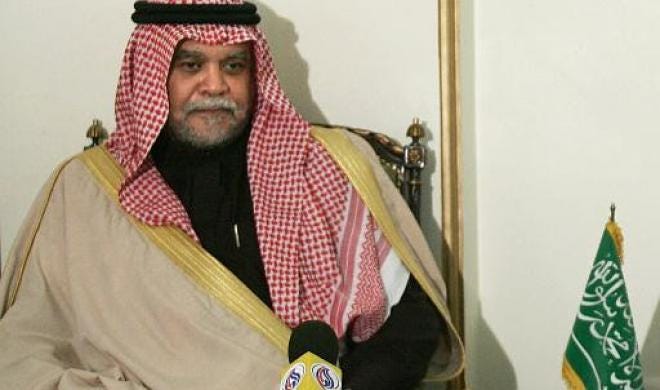
Then in early April, ISI chief Ahmad Shuja Pasha visited the US to discuss “intelligence cooperation.” Shahzad’s security sources told him that “the new security arrangement” being negotiated between the US, Saudi Arabia and Pakistan, “was high on the agenda.”
According to Hersh, a retired US government official was at that April meeting with Pasha: “Pasha told us at a meeting in April that he could not risk leaving bin Laden in the compound now that we know he’s there. Too many people in the Pakistani chain of command know about the mission… Of course the guys knew the target was bin Laden and he was there under Pakistani control.”
In the last week of April, Shahzad reported, the US’s top man in Afghanistan, Gen. David Petraeus, met with Pakistani military chief Gen. Kayani “and informed him of the US Navy Seals operation to catch a high-value target. The deal was done.”
By Hersh’s account, as early as January 2011, according to his retired US official, Kayani had agreed to a lethal strike on bin Laden: “He eventually tells us yes, but he says you can’t have a big strike force. You have to come in lean and mean. And you have to kill him, or there is no deal.”
That the ISI had a super secret unit dedicated solely to the task of ‘handling’ Osama bin Laden — and that “former senior American officials” had concluded the same — raises a host of issues. If bin Laden had a dedicated ISI handler, by definition he was operating as an agent on behalf of the ISI. And at least some senior US officials were aware of this.
If that is the case, then it also raises questions about the very nature of the intelligence sharing arrangements by which Pakistan was passing on intelligence to Americans relating to Abbottabad and Osama bin Laden.
How much did the Americans know about this operation? Reports from the Pakistan Foreign Ministry, Brigadier General Qadir, Syed Saleem Shahzad, among other sources, showed that Pakistan was routinely sharing intelligence on bin Laden’s movements and the Abbottabad compound with the US.
If Pakistani intelligence on bin Laden was, indeed, compartmentalised to a secret unit within the ISI under the authority of the most senior ISI officials, then the sharing of intelligence on his movements with the US (which apparently occurred about three months before the raid) could only have occurred as part of the same ‘handling’ arrangement, and with the approval of those officials — who would have exerted absolute control on how the ISI dealt with all intelligence related to bin Laden.
In internal emails obtained by Wikileaks, Stratfor’s Vice President for Intelligence Fred Burton — former deputy counter-terrorism chief at the State Department — told colleagues about information available to US government investigators:
“Mid to senior level ISI and Pak Mil with one retired Pak Mil General that had knowledge of the OBL arrangements and safe house. Names unk [unknown] to me and not provided. Specific ranks unk to me and not provided. But, I get a very clear sense we (US intel) know names and ranks.”
The leaked email stated that up to a dozen Pakistani ISI officials knew of bin Laden’s Abbottabad safe-house, and were in routine contact with the al-Qaeda chief.
In the context of the evidence already explored, the Stratfor correspondence suggests that contrary to official denials, US authorities not only knew that senior Pakistani military intelligence officers were harbouring Osama bin Laden since 2004, they knew that they were harbouring him in his Abbottabad compound for years, and by early 2011 they were working with the ISI in ongoing surveillance of the terror chief and his movements outside Abbottabad.
Collusion
Carlotta Gall’s account of bin Laden as an ISI intelligence asset is further corroborated by astonishing statements from former Pakistani Army and ISI chief, Gen. Ziauddin Butt, at a conference in October 2011.
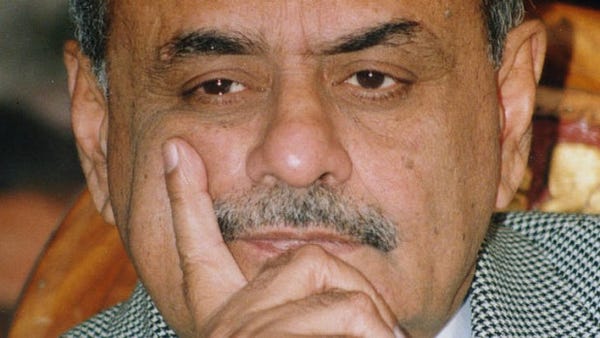
Butt told conference attendees that bin Laden’s compound in Abbottabad was in fact a safe-house used by a Pakistani intelligence agency, the Intelligence Bureau. He identified retired Intelligence Bureau chief Brigadier Ijaz Shah as the official responsible for keeping bin Laden there, with the knowledge and approval of Gen. Musharraf. If true, this would suggest that Brig. Ijaz Shah was bin Laden’s appointed ISI ‘handler.’
Lending credence to his claims, Pakistani intelligence officials had warned journalists present at the conference not to report Gen. Butt’s explosive revelations.
The Intelligence Bureau connection is crucial, as in the same NYT report, Gall refers to a Pakistani Interior Ministry Intelligence Bureau report documenting the surveillance of bin Laden’s movements outside Abbottabad to meet militants in 2009. This means that the intelligence unit that housed him was also the intelligence unit that monitored him.
Other senior ISI sources have also confirmed that bin Laden’s Abbottabad mansion was a safe-house used by the ISI. And a local police officer familiar with the compound said that the location was being used by Hizbul Mujahedeen, a militant group operating in disputed Kashmir, which has received extensive military and financial support from the ISI.
According to Pakistani security specialist Arif Jamal, writing for the Washington DC-based Jamestown Foundation’s Terrorism Monitor journal, “As an ISI officer he [Ijaz Shah] was also the handler for Omar Saeed Sheikh, who was involved in the kidnapping of Wall Street Journal journalist Daniel Pearl in 2002. Omar Saeed Sheikh surrendered to Brigadier Shah who hid him for several weeks before turning him over to authorities.”
Jamal refers to an interview in 2000 with a Pakistani security official, who disclosed Shah’s relationship with Ahmed Omar Sheikh Saeed on condition of anonymity.
Brig. Shah’s connection to Omar Sheikh Saeed is deeply troubling. Sheikh Saeed was not simply accused of murdering Daniel Pearl — he was al-Qaeda’s finance chief during the 9/11 attacks. After 9/11, Indian intelligence officials confirmed that then ISI director Gen. Mahmoud Ahmad had ordered Omar Saeed to wire at least $100,000 to the chief 9/11 hijacker, Mohammed Atta.
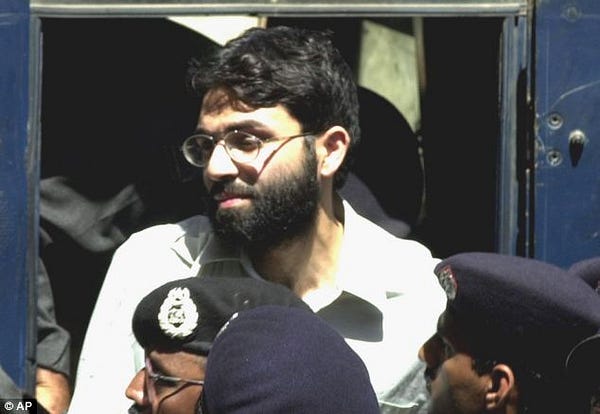
As I documented in my books The War on Truth (2005) and The War on Freedom (2002), which was among 99 books selected for the 9/11 Commissioners to use as part of their inquiries, multiple US intelligence investigations corroborated the Indian allegations. US authorities had further confirmed that Sheikh Saeed had wired as much as $500,000 if not more to several of the 9/11 hijackers — all at the behest of the ISI. Despite this, US authorities took no measures to designate or extradite either Sheikh Saeed or his ISI boss, Mahmoud Ahmad.
As former British Cabinet Minister Michael Meacher observed: “It is extraordinary that neither Ahmad nor Sheikh have been charged and brought to trial on this count [of financing 9/11]. Why not?”
In his memoirs, In the Line of Fire, Gen. Musharraf revealed that Omar Sheikh Saeed was a MI6 agent who had executed certain missions on behalf of the British intelligence agency, before travelling to Pakistan and Afghanistan where he met Osama bin laden and Mullah Omar.
Sheikh Saeed was first recruited by MI6 while at the London School of Economics, recounts Musharraf. The agency persuaded him to join anti-Serb demonstrations during the Bosnia conflict, and later sent him to Kosovo to join the jihad. Musharraf argues that at some point, Saeed likely became “a rogue or double agent.”
Musharraf’s claims are no doubt self-serving, deflecting from the widely-reported fact that Sheikh Saeed was an ISI asset. But they chime with other facts in the public record.
Former US Justice Department prosecutor John Loftus, for instance, who held top secret national security clearances, has confirmed that MI6 was working with leaders of the now banned British group al-Muhajiroun — Omar Bakri Mohammed, Abu Hamza and Haroon Rashid Aswat (who would later become bin Laden’s bodyguard) — to recruit British Muslims to fight in Kosovo in 1996.
Sheikh Saeed would have been part of that MI6-backed funnel. Others in Musharraf’s government were convinced that Sheikh Saeed was also a CIA asset. In a little-noted article on Saeed’s murky background in March 2002, the Pittsburgh Tribune-Review reported that: “There are many in Musharraf’s government who believe that Saeed Sheikh’s power comes not from the ISI, but from his connections with our own CIA.” Officials believe that “Saeed Sheikh was bought and paid for.”
Some senior US intelligence officials agree. John Newman, a former executive assistant to the director of the NSA who spent 20 years in the US Army Intelligence and Security Command, pointed out that despite Sheikh Saeed’s kidnapping of British citizens and related terror offenses, he faced no indictments from the US or Britain, and was even able to travel back to London in January 2000. He had also kidnapped American citizens, but faced no indictments from the US until after 9/11.
“Did the United States not indict Saeed Sheikh because he was a British informant? Did the agency [CIA] receive information provided by Saeed Sheikh from British or Pakistani intelligence?” asked Newman rhetorically at a 2005 Congressional briefing on the findings of the 9/11 Commission Report.
“This would help explain why Saeed Sheikh was not indicted and escaped justice for his crimes and traveled freely around England… If the foregoing analysis has any merit, Western intelligence agencies were receiving reports from a senior al-Qaeda source. Once again, however, al-Qaeda had used Western intelligence to accomplish its own mission. Saeed Sheikh was probably a triple agent.”
Ahmed Omar Sheikh Saeed’s role in the 9/11 attacks on behalf of the head of the ISI, Newman noted, was completely ignored by the 9/11 Commission Report. But the revelation that Sheikh Saeed was likely a triple agent of the ISI, CIA and MI6, also raises questions about bin Laden’s protection by the ISI after 9/11. The failure of US authorities to out Sheikh Saeed’s 9/11 role suggests that his freedom of movement before 9/11 was very much enabled by what Newman describes as his “triple agent” status.
In other words, bin Laden and Sheikh Saeed — apparently a CIA and MI6 asset — shared the same ISI handler, Brig. Ijaz Shah.
Newman argues, essentially, that the Sheikh Saeed story shows how US and British determination to maintain an intelligence asset in the heart of bin Laden’s operations, gave him and his associates an extraordinary freedom of impunity that blew up in our faces on 9/11.
Our jihadists
The Saudi-Pakistani arrangement at Abbottabad provided bin Laden with significant freedom of movement, and an ability to continue maintaining direct contact with al-Qaeda militants. Yet it also coincided with the acceleration of a covert US strategy launched to empower Sunni jihadists.
Around the middle of the last decade, the Bush administration decided to use Saudi Arabia to funnel millions of dollars to al-Qaeda affiliated jihadists, Salafi militants, and Muslim Brotherhood Islamists. The idea was to empower these groups across the Middle East and Central Asia, with a view to counter and rollback the geopolitical influence of Shi’ite Iran and Syria.
Seymour Hersh himself reported in detail on the unfolding of this strategy in the New Yorker in 2007, citing a range of US and Saudi government, intelligence and defence sources. The US-backed Saudi funding operation for Islamist militants, including groups affiliated with or sympathetic to al-Qaeda, was active as far back as 2005 according to Hersh — the same year that bin Laden’s move to Abbottabad under Saudi financial largess was approved.
The thrust of Hersh’s 2007 report has been widely confirmed elsewhere, including by several former senior government officials speaking on-the-record.
The existence of a US covert programme of this nature was corroborated by ABC News that very year.
Then in 2008, a US Presidential Finding disclosed that Bush had authorised an “unprecedented” covert offensive against Iran and Syria, across a huge geographical area from Lebanon to Afghanistan, permitting funding to anti-Shi’a groups including Sunni militant terrorists like the pro-al-Qaeda Jundullah, Iranian Kurdish nationalists, Baluchi Sunni fundamentalists, and the Ahwazi Arabs of southwest Iran. The CIA operation would receive an initial influx of $3–400 million.
Although spearheaded under Bush, the strategy escalated under the Obama administration.
Alastair Crooke, a retired 30-year MI6 officer and Middle East advisor to EU foreign policy chief Javier Solana, explained that the US-Saudi alliance would generate a resurgence of al-Qaeda jihadists:
“US officials speculated as to what might be done to block this vital corridor [from Iran to Syria], but it was Prince Bandar of Saudi Arabia who surprised them by saying that the solution was to harness Islamic forces. The Americans were intrigued, but could not deal with such people. Leave that to me, Bandar retorted.”
This regional strategy, Crooke said, involved the sponsorship of extremist Salafis in Syria, Libya, Egypt, Lebanon, Yemen, and Iraq “to disrupt and emasculate the [Arab Spring] awakenings that threaten absolute monarchism.”
The continuation of the strategy under Obama was also confirmed by John Hannah, former national security advisor to Vice President Dick Cheney, who remarked that:
“Bandar working as a partner with Washington against a common Iranian enemy is a major strategic asset.”
Mobilising extremist Sunnis “across the region” under “Saudi resources and prestige,” wrote Hannah, can “reinforce US policy and interests… weaken the Iranian mullahs; undermine the Assad regime; support a successful transition in Egypt; facilitate Qaddafi’s departure; reintegrate Iraq into the Arab fold; and encourage a negotiated solution in Yemen.”
The activation of the strategy was perhaps most clearly confirmed in a 2008 US Army-sponsored RAND Corp report, which recommended eight strategies for prosecuting the ‘war on terror’ in the region.
Among them was a recommendation to exploit “fault lines between the various SJ [Salafi-jihadist] groups to turn them against each other and dissipate their energy on internal conflicts,” for instance between “local SJ groups” focused on “overthrowing their national government” and transnational jihadists like al-Qaeda. The US “could use the nationalist jihadists to launch proxy IO [information operation] campaigns to discredit the transnational jihadists.”
The US could also “choose to capitalise on the Shia-Sunni conflict by taking the side of the conservative Sunni regimes in a decisive fashion and working with them against all Shiite empowerment movements in the Muslim world… to split the jihadist movement between Shiites and Sunnis.” The US would need to contain “Iranian power and influence” in the Gulf by “shoring up the traditional Sunni regimes in Saudi Arabia, Egypt, and Pakistan.”
Although this would mean empowering al-Qaeda’s chief financial backers among Sunni states, the widening Sunni-Shia sectarian conflict would “reduce the al-Qaeda threat to US interests in the short term,” by diverting Salafi-jihadist resources toward “targeting Iranian interests throughout the Middle East,” especially in Iraq and Lebanon, hence “cutting back… anti-Western operations.”
The same US Army-backed RAND report confirmed that this “divide and rule” strategy had already been activated in the region, specifically in Iraq:
“Today in Iraq such a strategy is being used at the tactical level, as the United States now forms temporary alliances with nationalist insurgent groups that it has been fighting for four years… In the past, these nationalists have cooperated with al-Qaeda against US forces.”
Bringing all this together implies that in the same year that the Pakistani ISI received funding from Saudi Arabia to harbour bin Laden in his custom-built mansion in Abbottabad, the US had covertly partnered with Saudi Arabia to support al-Qaeda affiliated groups as part of a highly clandestine divide-and-rule strategy to counter Iranian influence.
Quoting Hersh from his 2007 report, a US government consultant told him that Prince Bandar bin Sultan and other Saudis had assured the White House that:
“… they will keep a very close eye on the religious fundamentalists. Their message to us was ‘We’ve created this movement, and we can control it.’ It’s not that we don’t want the Salafis to throw bombs; it’s who they throw them at — Hezbollah, Moqtada al-Sadr, Iran, and at the Syrians, if they continue to work with Hezbollah and Iran.”
Thus, the key US contact in Saudi Arabia responsible for the covert ‘redirection’ strategy at its origination was Prince Bandar bin Sultan, then Secretary-General of Saudi’s National Security Council.
As reported by Saleem Shahzad, Prince Bandar — who knew bin Laden personally from their Cold War days — had also met with US and Pakistani officials in the months leading up to the bin Laden raid.
In other words, Prince Bandar was the same senior Saudi official who helped negotiate the agreement under which the Abbottabad operation would be executed in 2011, and who had been tapped under both Obama and Bush to accelerate Saudi funding of Islamist militants to counter Iran.
Yet US officials knew that Bandar was linked directly to the events of 9/11. In tapping the Prince to assist with the anti-Iran strategy and the Pakistan-bin Laden strategy, US officials knowingly collaborated with a Saudi royal who had financed the 9/11 hijackers.
In his book Intelligence Matters (2004), Senator Bob Graham, co-chair of the Congressional Inquiry into 9/11, discusses the contents of a top secret CIA memo dated 2nd August 2002 about two 9/11 hijackers, Khalid Almihdhar and Nawaf Alhazmi. The CIA memo concluded that there is “incontrovertible evidence that there is support for these terrorists within the Saudi government.”
The 28 page section of the Congressional report including discussion of the CIA memo was classified, but some of its contents were leaked, and related issues revealed in press reports. Early in 2000, when Almidhar and Alhazmi arrived at Los Angeles airport, they were picked up by a fellow Saudi, Omar al-Bayoumi, who gave them $1,500 in cash, moved them into his apartment building, and helped them apply for flight school.
Al-Bayoumi worked for Dallah Avco, a Saudi-based airline chaired by Prince Bandar’s father, Prince Sultan bin Abdulaziz. The firm is a major contractor for the Saudi Ministry of Defense and Aviation.
In the following months, al-Bayoumi and his associates received regular cashier’s cheques of around $2,000 a month, totaling tens of thousands of dollars. These came from Prince Bandar and his wife, Princess Haifa bint Faisal. Both Bandar and his wife claimed the money was donated for charitable purposes (one payment track was made after one of al-Bayoumi’s associates requested assistance from the Saudi embassy for thyroid treatment), and that they had no idea it was being diverted to fund the 9/11 hijackers.
After 9/11, British authorities questioned al-Bayoumi in London about the Saudi money trail to bin Laden’s hijackers. They had discovered secret papers with the private phone numbers of senior Saudi government officials concealed beneath the floorboards of his flat in London. The investigation went nowhere: al-Bayoumi was soon released, and disappeared into Saudi Arabia.
This disturbing background shows that Prince Bandar was connected to the 9/11 attacks, but protected by US authorities; that he was the White House’s point-man to launch the wider US-Saudi covert arrangement to fund al-Qaeda affiliated groups (coinciding with bin Laden’s move to Abbottabad with Saudi funding); and that by 2011, he was privy to Pakistan’s harbouring of al-Qaeda’s leader and the US-Pakistan arrangement that led to his assassination.
Throughout this period, senior US intelligence officials have said that Osama bin Laden was actively engaged in directing the very al-Qaeda terror activity that Saudi Arabia was busy financing, while also financing bin Laden’s ISI-controlled base in Abbottabad.
“This compound in Abbottabad was an active command and control center for al Qaeda’s top leader and it’s clear… that he was not just a strategic thinker for the group,” said one official. “He was active in operational planning and in driving tactical decisions.”
That claim is consistent with information on bin Laden’s activity contained in the Afghan War logs. The overwhelming implication, and the consistent role of Prince Bandar in the alignment of these events, is that the US-backed Saudi programme to “control” who bin Laden-affiliated Salafis “throw bombs” at, gave bin Laden a free-hand to accelerate his terrorist activity under the auspices of the ISI.
The US-led strategy had, it seems, enabled the Saudi-Pakistani arrangement with the al-Qaeda founder as a matter of geopolitical convenience to undermine Iran.
The great escape
Credible reports of bin Laden’s connections to the Haqqani network also point to the role of the Saudi and Pakistani states in protecting bin Laden.
Two months before the US raid on his Abbottabad mansion, a BBC interview with senior officials of the Haqqani network confirmed a meeting with Osama bin Laden in Chitral in the northwest Pakistan frontier region.
The Haqqani network points directly to the ISI. In his testimony before the US Senate in September 2011, then outgoing chairman of the Joint Chiefs of Staff, Admiral Mike Mullen, said that “credible intelligence” confirms that “the Haqqani network… acts as a veritable arm of Pakistan’s Inter-Services Intelligence agency.”
This intelligence goes back many years. In 2008, for instance, confidential NATO reports and US intelligence assessments circulated among senior White House officials confirmed that Pakistan’s ISI at the highest levels had provided military support to Taliban insurgents, particularly the Haqqani network. Gen. Ashfaq Kayani, who according to Hersh was complicit in protecting bin Laden in Abbottabad, had been identified as sanctioning provision of military aid to insurgents affiliated to bin Laden.
In fact, US and British intelligence analyses from just before 9/11 right up until the bin Laden raid not only show that the ISI has supported such al-Qaeda linked insurgent groups in Pakistan and Afghanistan throughout that period, but that US and British officials were well aware of the same.
Various credible sources report that the Haqqani network, with assistance from the ISI, had played a key role in bin Laden’s escape from the Tora Bora complex in 2001 into Pakistan in the wake of the US bombing campaign.
In the New Yorker, Dexter Filkins cites Afghanistan’s intelligence chief from 2004 to 2010, Amrullah Saleh, who told him that ISI operative Syed Akbar Sabir had escorted bin Laden from Chitral to Peshawar in Pakistan: “We believed that he was part of the ISI operation to care for bin Laden.”
Another ISI agent, Fida Muhammad, had confessed to the Afghans that he had been escorting Haqqani insurgents from Pakistan into Afghanistan to fight the NATO occupation for the previous decade. But his most “memorable” job was in December 2001, when he participated in a major ISI covert operation — sanctioned at the highest levels — to help al-Qaeda fighters escape from Tora Bora.
There were dozens of ISI teams operating on the ground at the time who successfully evacuated as many as 1,500 militants from Tora Bora and other jihadist camps.
In his New Yorker story, Filkins quotes former CIA counter-terrorism officer Bruce Riedel on former ISI chief Nadeem Taj, whom he described as being “deeply involved with Pakistani militants, particularly those fighting against India.”
But as Filkins observes:
“Before taking over the ISI, Taj was the commandant of the Pakistani military academy in Abbottabad. That is, he was the senior military official in Abbottabad at the time that American officials believe bin Laden began living there. Taj retired from the Pakistani Army in April, just days before the raid in Abbottabad. Attempts to track him down in Pakistan were unsuccessful.”
According to a 2009 Senate Committee on Foreign Relations report into the Tora Bora debacle, US intelligence had confirmed bin Laden’s presence among al-Qaeda fighters, during the December 2001 bombing campaign — a matter confirmed by the official history of the US Special Operations Command.
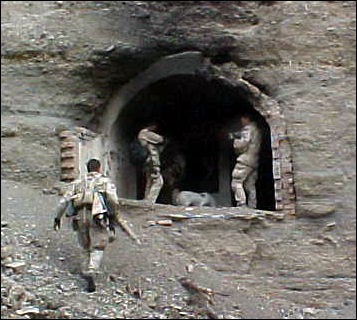
Yet the commander of the operation, General Tommy Franks, Vice President Dick Cheney, and other senior officials claimed falsely that “the intelligence was inconclusive about the Al Qaeda leader’s location.”
Gen. Franks to this day justifies the decision on an outright lie: “I have yet to see anything that proves bin Laden or whomever was there.”
In reality, the Senate report proves that White House and military officials knew bin Laden was there, and were warned repeatedly that the failure to mobilise US forces to block the wide-open routes into Pakistan would result in his escape.
Henry Crumpton, head of special operations for the CIA’s counter-terrrorism division and chief of its Afghan strategy, had told the Bush administration that “we’re going to lose our prey [bin Laden]” without bringing in US marines already stationed in Kandahar to block those routes.
“The decision not to deploy American forces to go after bin Laden or block his escape,” the Senate report noted, “was made by Secretary of Defense Donald Rumsfeld and his top commander, General Tommy Franks.”
“The implications of these statements are that bin Laden was alive and was allowed to escape,” said Prof. Sunil Ram of the American Military University, writing in the respected Canadian defence journal, Frontline Defence.
Just a month earlier, the Pentagon was directly complicit in secret Pakistani military airlifts into Kunduz which rescued beleaguered Taliban and al-Qaeda fighters from America’s elite Delta Force units on the ground. A CIA official and a Delta Force military analyst told Seymour Hersh for the New Yorker that “the Administration ordered the United States Central Command to set up a special air corridor to help insure the safety of the Pakistani rescue flights.”
The operation was purportedly undertaken to save Pakistani military and intelligence operatives on the ground in Kunduz, whose deaths under US bombing would jeopardise the political survival of Pakistan’s then leader, Gen. Pervez Musharraf.
Yet on 21st November, in response to questions from journalists about reports of the airlifts, Rumsfeld denied the Pentagon’s involvement while also inadvertently revealing his knowledge of the operation’s foreseeable consequences:
“Any idea that those people should be let loose on any basis at all to leave that country and to go bring terror to other countries and destabilise other countries is unacceptable.”
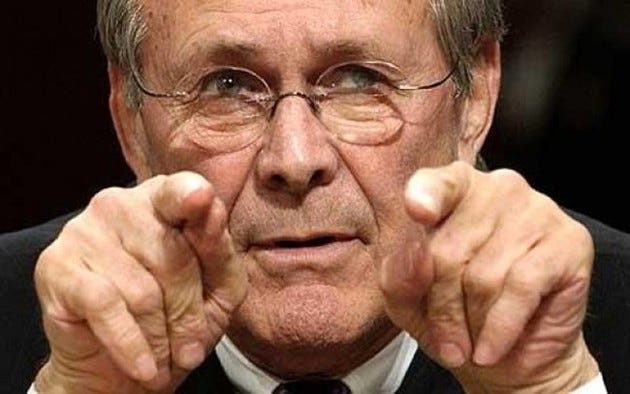
In other words, senior White House and Pentagon officials were complicit in ISI operations that foreseeably “let loose” Laden’s Taliban and al-Qaeda fighters to “go bring terror to other countries.”
According to Prof. Ram, who was a senior military strategy advisor to the Saudi Royal family for over a decade:
“The Battle of Tora Bora obviously raises the question why was he [bin Laden] allowed to escape? … if US Special Forces had killed or captured him in Tora Bora in 2001, the basic justification for the Global War on Terror would have been eliminated and the subsequent (and false) claims of links between al-Qaeda and Iraq would have been meaningless.”
He points out that many of the “expansionist policies” subsequently pursued by the Bush administration as outlined by the neoconservative think-tank, the Project for a New American Century, would have had little traction had al-Qaeda been routed and bin Laden killed in Tora Bora.
“The US would have been hard pressed to convince anyone of the need to invade Iraq or continue the war in Afghanistan,” concludes Ram, who was previously an editor at SITREP, the defence journal of the Royal Canadian Military Institute, where he sat on the Defence Studies Committee. “Thus, logic dictates that bin Laden was allowed to escape into Pakistan in late 2001.”
The Haqqani network, which appeared to have been integral to the post-9/11 ISI operation “to care for bin Laden,” to quote Afghanistan’s former intelligence czar, Amrullah Saleh, also remains connected to Saudi Arabia.
The latest batch of confidential Saudi diplomatic cables released by Wikileaks contains documents revealing that the Saudi ambassador to Pakistan met in February 2012 with Nasiruddin Haqqani, the jihadist group’s chief fundraiser at the time, and the son of Jalaluddin Haqqani, the group’s founder. Nasiruddin was later killed in a shooting in Islamabad in November 2013.
The documents show that Nasiruddin asked the Saudi ambassador to convey to the Saudi king his father’s wish for treatment in a Saudi hospital, and mentions that Jalaluddin Haqqani holds a Saudi passport. Another document shows that a senior Saudi foreign ministry official then recommended that the treatment go ahead — although it remains unclear whether it actually did.
Previous US diplomatic cables released by Wikileaks confirmed US intelligence has been well aware for years that Taliban and Haqqani network fundraisers and associates were routinely residing in or travelling to Saudi Arabia, where they engaged in fundraising activities.
While documenting apparent Saudi cooperation with the US to disrupt terror support activities inside Saudi Arabia, the new leaked Saudi cables show that Saudi officials at the highest level are still courting the same militant networks abroad.
In other words, senior Saudi and Pakistani government officials until well after the bin Laden raid have retained close ties to the Haqqani network — the same network which under ISI purview facilitated bin Laden’s escape from Tora Bora in 2001, and with which bin Laden met just months before the May 2011 raid.
The split
But despite bin Laden’s ongoing involvement in directing militant activity, often in liaison with groups supportive of al-Qaeda like the Haqqani network, there can be little doubt that his role in al-Qaeda had significantly reduced.
According to Pakistani tribal sources cited by Gareth Porter who were familiar with bin Laden’s presence in South Waziristan shortly after 9/11, bin Laden had been increasingly sidelined by other al-Qaeda leaders, including his deputy Ayman al-Zawahiri.
But Porter vastly overstates his case in arguing that bin Laden’s role in al-Qaeda had become virtually mute — an idea put forward by the US West Point Military Academy’s Counter Terrorism Center which released the bin Laden files.
The latest detailed analysis of the documents from the Abbottabad compound show that bin Laden had overseen the dispatch of al-Qaeda forces across the Middle East from Yemen to Libya, where for instance one of his deputies informed him of “an active Jihadist Islamic renaissance underway in Eastern Libya (Benghazi, Derna, Bayda and that area).”
The Abbottabad documents also confirmed that in the months before bin Laden’s death, al-Qaeda’s leadership and sponsors in the Pakistani ISI were — as with Hekmatyar — actively seeking some sort of accommodation with the Americans.
The documents recorded former ISI chief Hamid Gul telling his al-Qaeda contacts: “We are putting pressure on them [America] to negotiate with al-Qaeda . . . [and] that negotiating with the Taliban separate from al-Qaeda is pointless.”
But the most intriguing revelation is that Bin Laden’s deputy, Atiyah Abd al-Rahman, told bin Laden in early 2011 that UK security services were in contact with Libyan al-Qaeda operatives in Britain:
“British Intelligence spoke to them (these Libyan brothers in England), and asked them to try to contact the people they knew in al Qaeda to inform them of and find out what they think about the following idea: England is ready to leave Afghanistan [if] al Qaeda would explicitly commit to not moving against England or her interests.”
This proposal had been relayed through an al-Qaeda operative in Libya, then in hiding in Iran, who was in contact with “some Libyan brothers in England.”
It should be noted that in 2007, documents leaked by Snowden showed that the NSA had acknowledged tracking a “communications path” from Osama bin Laden in Pakistan to al-Qaeda leaders in Iraq and Iran.
The new proposal offered a repeat of what British security officials have described as an informal ‘covenant of security’ with Islamists that had been in place during the Cold War and through the 1990s.
According to Lieutenant Colonel Crispin Black, a former UK Cabinet Office intelligence advisor to the Prime Minister, under the ‘covenant of security’ Islamist militants would be able to reside unmolested in Britain and plot to their hearts’ content, as long as they refrained from targeting Britain or British interests.
Al-Rahman went on in the letter to explain how he had already responded to the British proposal:
“I wrote: we can consider the matter and come up with something appropriate along this vein. I will convey the idea to the leadership. He may have told the Libyan brothers by now, and they may have told the British.”
However, bin Laden was intent on rejecting the proposal. A letter to al-Rahman from bin Laden dated 26th April 2011 records the latter’s conviction that UK forces were “sure of being defeated”:
“Regarding what you mentioned about the British intelligence saying that England is going to leave Afghanistan if al-Qaeda promised not to target their interests… I say that we do not enable them on that, but without slamming the door completely closed.”
For bin Laden, the emphasis was on avoiding any such accommodations with the West, telling al-Rahman: “We would like to neutralise whomever we possibly can during our war with our bigger enemy, America.”
Al-Qaeda had, in that context, offered a truce to bin Laden’s Pakistani benefactors, on condition that they cease cooperation with the US: “You became part of the battle when you sided with the Americans. If you were to leave us and our affairs alone, we would leave you alone.”
Extraordinarily, bin Laden was able to use his position from Abbottabad to freely threaten Pakistan with further domestic al-Qaeda terrorist attacks due to the government’s ongoing coordination with the Americans.
The documents show that bin Laden remained obsessed with organising a “large operation inside America [that] affects the security and nerves of 300 million Americans.”
As for the Middle East, bin Laden’s 26th April letter further revealed that he saw the Arab Spring revolutions as an opportunity for the emergence of populist Islamic governments, largely led by the Muslim Brotherhood. He urged Rahman to warn “our brothers in the regions… of entering into confrontations with the parties belonging to Islam, and it is probable that most of the areas will have governments established on the remnants of the previous governments, and most probable these governments will belong to the Islamic parties and groups, like the Brotherhood and the like.”
Al-Qaeda jihadists should cooperate with the emerging governments, “as the current conditions have brought on unprecedented opportunities and the coming of Islamic governments that follow the Salafi doctrine is a benefit to Islam.”
The spate of meetings bin Laden had pursued with militants across Pakistan in the months before the raid were the terror chief’s efforts to enjoin that vision and secure the support of comrades. Hekmatyar, for instance, whom bin Laden had met according to Shahzad Saleem, was already working on accommodating with the Americans. Bin Laden, however, was clearly against this strategy, and wanted to Hekmatyar and others to instead pursue his ‘big tent’ strategy to focus on hitting the US hard.
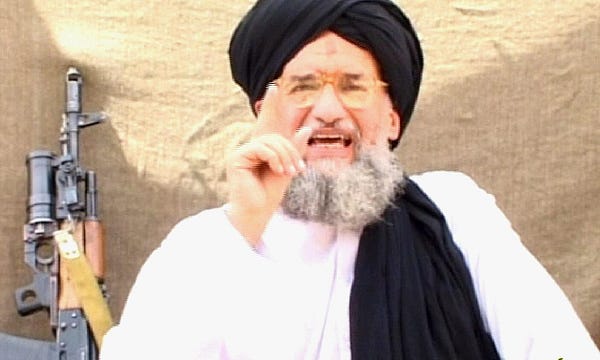
In contrast, bin Laden’s second-in-command, Ayman al-Zawahiri, had a very different strategy of response to the Arab revolutions. Inspired by his personal experience of the intolerance to “Islamic militancy” under US-backed Muslim regimes during the Cold War, Shahzad Saleem reported that in the months prior to bin Laden’s death:
“Zawahiri therefore promoted the idea of ideological divides within the Muslim world, and encouraged revolts and terrorism to polarise societies to such a point of chaos that they would be unmanageable and amenable to Western intervention. It was believed that such intervention would open the gates for a battle between the West and the Muslim world.”
The al-Qaeda number two“encouraged narrow ideological views in resistance movements as a strategy to boost revolts against Muslim-majority states,” thoroughly different to bin Laden’s new policy of a re-unification between al-Qaeda and other non-violent Islamist groups.
But Zawahiri’s approach was “shot down” by other senior al-Qaeda leaders, including Sulaiman Abu al-Gaith and Saif al-Adel. They agreed with bin Laden’s vision of al-Qaeda reviving contacts with old networks with “Muslim Brotherhood and Palestinian groups” to “join forces with mainstream Muslim groups” and launch a “joint struggle against Western interests in the Muslim world.”
Betrayal
Zawahiri’s plan was to play the long-game: rather than focusing on Western “heartlands” with spectacular operations, he wanted al-Qaeda to fracture the most strategic regions of the Muslim world, bogging down Western militaries in prolonged insurgencies that would, eventually, coalesce into a major confrontation.
Zawahiri’s vision of polarising Muslim societies along sectarian lines aligned alarmingly well with the Pentagon’s own regional divide-and-rule strategies to foster Salafi jihadists as a way to not just undercut Iran and Syria, but even undermine the potency of democratic uprisings that threatened to endanger the Gulf regimes. It also, of course, appeared to reduce the risk of major mass casualty attacks.
Four days after writing his letter declining the British offer of a renewed ‘covenant of security’, bin Laden’s Abbottabad compound was raided, and the terror chief killed.
By facilitating the assassination of Osama bin Laden, US, Saudi and Pakistani intelligence agencies resolved the internal debate among the terror group’s leadership. While they aborted bin Laden’s vision of a united Muslim world hell-bent on destroying the West, in doing so, they brought to the fore bin Laden’s lieutenant Zawahiri, who was also under Pakistani protection at the time according to ISI sources.
In her book The Wrong Enemy (2014), Carlotta Gall reports that Afghan national security officials were informed by a Pashtun tribal elder in 2005 that al-Zawahiri was “staying as a guest at the house of a senior Pakistani government official in Kohat” — that official was “the governor of the North West Frontier province, a retired general, and a Musharraf appointee.”
The information was passed on to President Karzai, and given US-Afghan intelligence sharing arrangements, would likely have been passed on to the Americans. According to Gall, after the bin Laden raid, “two American counterterrorism officials told me that the account of Zawahiri’s hiding place was entirely possible and that they had seen similar such reports.”
That protection continues to this day. “There are indicators that some elements of the Pakistani government may be protecting Zawahiri,” one US intelligence official told Newsweek a year after the raid. “We have reports that he’s been hanging out in Karachi for brief periods, and we just don’t think he’s going to be doing that without a lot of people knowing about it.”
Back in October 2010, a senior NATO intelligence official told CNN that alongside bin Laden, Zawahiri’s location had also been determined by US intelligence, and that both were living “comfortably” in Pakistan nearby each other, under ISI protection. The revelation indicated that US intelligence on bin Laden’s presence in Abbottabad had also identified Zawahiri’s location.
The 2008 Pentagon memo on Abu al-Libi had also showed that since 2005, the CIA was aware that bin Laden and Zawahiri had remained in close proximity, including during bin Laden’s shift toward Abbottabad.
But the US, Saudi Arabia and Pakistan had chosen to target bin Laden, alone.
Under Zawahiri’s watch, al-Qaeda’s activities in the region accelerated across the region in Iraq, Syria, Yemen, Libya, Somalia, Algeria and beyond. The upshot of these activities has not been to align with other Islamist forces, but to accentuate splits within the Salafi-jihadist movements, and within broader Islamist and Salafi movements overall.
This has increasingly ended up serving US geopolitical interests. For instance, the al-Qaeda-affiliated Libyan Islamic Fighting Group (LIFG), whose fighters reported directly to various senior al-Qaeda deputies, played a key role in the rebellion that toppled Col. Gaddafi, under the sponsorship and protection of NATO.
A Canadian intelligence report from 2009 described the rebel stronghold of eastern Libya as an “epicentre of Islamist extremism”, from which “extremist cells” operated in the region. The intelligence report confirmed that “several Islamist insurgent groups” were based in eastern Libya, many of whom were also “urging followers to fight in Iraq.”
During NATO’s intervention in Libya, al-Qaeda’s integral presence on the ground as part of the rebellion led Canadian pilots to joke privately that they were al-Qaeda’s air force, “since their bombing runs helped to pave the way for rebels aligned with the terrorist group.”
By the following year, US-backed support for al-Qaeda affiliated groups through regional allies — the Gulf regimes and Turkey — focused on Syria. Saudi Arabia played a lead role in the strategy under the helm of none other than Prince Bandar, who in 2012 was appointed Director General of the Saudi Intelligence Agency.
In my exclusive investigation last month, I explored the startling implications of a declassified Defence Intelligence Agency (DIA) report revealing that in its drive to topple Bashar al-Assad’s regime in Syria, the West oversaw these allies in supporting Islamist extremist rebels, including “al-Qaeda in Iraq.”
The Pentagon report showed that in August 2012, two years before ISIS invaded Iraq, the DIA had received raw information that the support for al-Qaeda linked rebels threatened to spawn a “Salafist Principality” in eastern Syria that could, further, give rise to an “Islamic State” across Iraq and Syria.
Three years down the line, under an ongoing US-backed rebel supply and training operation, the Saudis, Turks and Qataris are continuing the same strategy that generated ISIS, by openly sponsoring an “Islamist-dominated rebel alliance” in Syria, in which the al-Qaeda-affiliated Nusra front is the major player.
“It is unlikely we are going to operate side by side with cadres from Nusra, but if our allies are working with them, that is acceptable,” said former NATO Supreme Allied Commander, Adm. James Stavrids. The US is likely to go “pretty far… in terms of engaging with that coalition.”
In reality, little has changed since the good old days driving the Soviets from Afghanistan.
Protection racket
Given bin Laden’s increasing hostility toward any sort of accommodation with the Americans before his death, the al-Qaeda founder may well be turning in his grave at the actions of his successor.
The assassination of bin Laden has paved the way for the complete opposite of bin Laden’s grand vision of crumbling Muslim regimes overtaken by populist “Islamic governments.” Instead, his death has heralded the resurgence of a new geopolitical alliance between the West, the Gulf regimes, Turkey, and al-Qaeda.
It is therefore not surprising that to this day, successive US governments continue to systematically downplay the extent to which the governments of Saudi Arabia and Pakistan have deliberately fostered the infrastructure and support network for Osama bin Laden’s Islamist terrorist activity — much of which has occurred while in receipt of extensive Western financial and military aid.
As noted above, just before publishing its report in 2004, the 9/11 Commission received a confidential document from a high-level “unimpeachable source” in Pakistan. The report, commissioned by Zelikow, was damning:
“The imprints of every major act of international Islamist terrorism invariably passes through Pakistan, right from 9/11 — where virtually all the participants had trained, resided or met in, coordinated with, or received funding from or through Pakistan — to major acts of terrorism across South Asia and Southeast Asia, as well as major networks of terror that have been discovered in Europe.”
The document went so far as to reveal that repeated claims about bin Laden’s premature death could be traced back to ISI disinformation, put out to deflect attention from the agency’s complicity in harbouring and promoting al-Qaeda:
“ISI has consistently sought to deny the presence of al-Qaida elements in Pakistan, and to mislead US investigators… This deception has been at the very highest level, and Musharraf himself, for instance, initially insisted he was ‘certain’ bin Laden was dead.”
Musharraf, of course, according to former ISI chief Gen. Ziauddin Butt, was responsible for approving bin Laden’s protection at the Abbottabad compound under the jurisdiction of Brig. Ijaz Shah and the Pakistani Intelligence Bureau.
“ISI issues money and directions to militant groups, specially the Arab hijackers of 9/11 from al-Qaida. ISI was fully involved in devising and helping the entire affair. And that is why people like Hamid Gul and others very quickly stated the propaganda that CIA and Mossad did it.”
The report noted that although bin Laden was very much alive, reports of his being ill are accurate. The terror chief suffered “from renal deficiency [and] has been periodically undergoing dialysis in a Peshawar military hospital with the knowledge and approval of ISI if not of Gen. Pervez Musharraf himself.”
The source of the report even speculated: “Musharraf may be planning to turn over bin Laden to President Bush in time to clinch his reelection bid in November.”
Thus, in 2004, the US government-appointed commission to investigate 9/11 — staffed with former and active government and intelligence advisors — received startling information that Musharraf and the ISI were not only harbouring bin Laden and fabricating reports of his death, but were willing to hand him over to the US to aid with political point-scoring.
To this day, this unpublished 9/11 Commission addendum on Pakistan remains classified.
The US record on Saudi Arabia is equally damning. The infamous classified 28 pages of the 2002 Congressional Inquiry Report into 9/11 has been described by the inquiry’s co-chair Senator Bob Graham as providing shocking confirmation of the role of senior Saudi officials in not just sponsoring al-Qaeda, but providing specific financial support to the 9/11 hijackers and the operation itself. This January, he told a press conference:
“What would you think the Saudis’ position would be, if they knew what they had done, they knew that the United States knew what they had done, and they also observed that the United States had taken a position of either passivity, or actual hostility to letting those facts be known?”
The US has turned a blind eye to the Saudi relationship with bin Laden since the end of the Cold War.
A classified US intelligence report revealed by journalist Gerald Posner in his book Why America Slept (2003), confirmed that the US was fully aware of a secret deal struck in April 1991 between Saudi Arabia and bin Laden, then under house arrest in the kingdom. Under the deal, bin Laden could leave the kingdom with his funding and supporters, and continue to receive financial support from the Saudi royal family, on one condition: that he refrain from targeting and destabilising the Saudi kingdom itself.
After 9/11, a former head of Taliban intelligence, Mohammed Khaksar, gave sworn statements to US intelligence alleging that in 1998, Prince Turki al-Faisal (then Saudi intelligence chief) had renewed this deal with bin Laden. Saudi Arabia agreed to provide material aid to the Taliban and al-Qaeda, along with continued funding to bin Laden through Saudi charities and businesses. In return, al-Qaeda agreed not to attack Saudi targets.
And in 2005, when the Saudis were accelerating support to groups linked to al-Qaeda as part of the Bush ‘redirection’ to counter Iran, bin Laden was being protected by Pakistani intelligence with Saudi funding.
Former Canadian diplomat Prof. Peter Dale Scott, a leading authority on US covert operations, writes about this nexus in his landmark book American Deep State (2014). He argues that US protection of Saudi Arabia’s terrorism infrastructure boils down to the existence of “a vital triangle at the heart of the American deep state, in which oil companies paid Saudi Arabia for oil; Saudi Arabia paid the US arms industry for planes and weapons, and the resulting huge arms contracts paid for of-the-books US covert operations like Iran-Contra.”
This nexus of power undermines establishment claims that “the wars fought by America in Asia since 9/11 have been part of a global ‘war on terror.’” In reality, says Scott, this “pseudowar” has been fought “in alliance with Saudi Arabia, Qatar, and Pakistan — precisely the principal political and financial backers of the al-Qaedist networks the United States has supposedly been fighting.”
That compartmentalised nexus of power was responsible for harbouring Osama bin Laden since the very beginning.
Origins
After 9/11, the CIA issued a formal denial of having ever had a direct relationship with bin Laden:
“Numerous comments in the media recently have reiterated a widely circulated but incorrect notion that the CIA once had a relationship with Usama Bin Laden. For the record, you should know that the CIA never employed, paid, or maintained any relationship whatsoever with Bin Laden.”
This is false, but throws light on how the bin Laden operation was outsourced to Saudi Arabia and Pakistan precisely to enable the US to deny responsibility.
In 1984, bin Laden and his mentor, Abdullah Azzam, established the charity front, Maktab al-Khidamat (MAK) (which means “Services Office”), also known as al-Kifah, to funnel money, arms and fighters to Afghanistan. Bin Laden himself moved to Peshawar, a Pakistani town bordering Afghanistan, to help run MAK.
The 9/11 Commission Report describes MAK as the “precursor organisation to al-Qaeda,” but denies that MAK received any assistance from the US in the context of the war against the Soviets.
Yet as Michael Moran reported for MSNBC, “What the CIA bio conveniently fails to specify (in its unclassified form, at least) is that the MAK was nurtured by Pakistan’s state security services, the Inter-Services Intelligence agency, or ISI, the CIA’s primary conduit for conducting the covert war against Moscow’s occupation.”
The ISI’s handling of bin Laden’s MAK was done under the rubric of the CIA, by way of ‘plausible deniability.’ In his book Prelude to Terror: The Rise of the Bush Dynasty, the Rogue CIA and the Compromising of American Intelligence (2005), investigative journalist Joseph Trento, formerly of CNN’s Special Assignment unit and now at the National Security News Service, reported:
“Azzam joined forces with bin Laden in operating a recruiting center — Maktab al-Khidamat (MAK — Services Office). Though this was all fully known to the CIA, the Agency’s regional experts asked no questions… CIA money was actually funneled to MAK, since it was recruiting young men to come join the jihad in Afghanistan. (This information comes from a former CIA officer who actually filed these reports; we can’t identify him here because at the time of the writing of this book, he was back in Afghanistan as a private contractor).”
Trento goes on to note that “bin Laden’s opening MAK branch offices in the United States, Europe, and Asia was applauded by the CIA.” By some estimates, the MAK network recruited over 25,000 foreign jihadis into the Afghan war.
MAK opened up branches in 30 American cities alone. Its New York branch in Brooklyn was known as the al-Kifah Refugee Centre. Apart from the CIA, its donors included the Saudi intelligence agency, the Saudi Red Crescent, the Muslim World League, and private donors, including Saudi princes, according to the Pakistani journalist, Ahmed Rashid, in his seminal book, Taliban.
Al-Kifah routinely operated terrorist training camps inside the US with CIA approval. According to French journalist Richard Labeviere, former head of Radio France International and editor of Defence, the journal of the Paris-based Institute for Higher National Defence Studies which operates under the authority of the Prime Minister, al-Kifah even had a training camp in Connecticut, where “recruits received brief paramilitary training and weapons induction.” Writing in his book, Dollars for Terror (1999), Labeviere added that former “active service” members of the CIA were employed at the camp as “expert consultants.”
Former Sunday Times investigative journalist Simon Reeve further reported in his book, The New Jackals (1999), that US officials had direct contact with bin Laden. “American emissaries are understood to have traveled to Pakistan for meetings with mujaheddin leaders.” He cites a former CIA official who said that “the US emissaries met directly with bin Laden, and that it was bin Laden, acting on advice from his friends in Saudi intelligence, who first suggested the mujaheddin should be given Stingers.”
Those Stingers went to bin Laden’s colleague Hekmatyar, who commandeered the bulk of US, Saudi and Pakistani aid to the mujahideen network.
To help run the most controversial elements of this covert operations programme, the Pentagon was allowed to establish a new US Army Special Operations division “to conceal from Congress and the media, and probably also from other executive agencies, details of covert overseas operations in Afghanistan and elsewhere and their financing,” according to former ABC News journalist John K. Cooley in his classic book, Unholy Wars. These programmes reported to a group “which the Pentagon never publicly acknowledged to exist: the Intelligence Support Activity (ISA).”
The secret raid
ISA’s highly compartmentalised Afghanistan operations were code-named ‘Gray Fox,’ and also worked closely with the CIA’s paramilitary Special Activities Division.
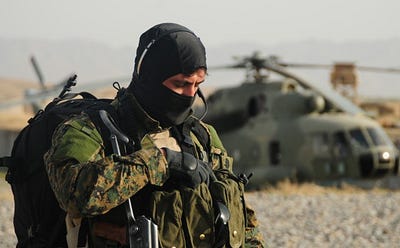
Since then, the Activity has run under numerous other code-names, the latest of which is unknown.
Operating through its own command-and-control structure, the ISA is entirely free from Congressional oversight, and due to the extreme secrecy of its operations, even remains opaque to senior White House officials.
In July 2002, as Jeremy Scahill reported in Dirty Wars (2013), the ISA was transferred to the Joint Special Operations Command (JSOC) to focus on combining surveillance, field interrogations and “the running of local sources and assets.”
Under the greatly expanded and newly revamped ISA, as revealed by a 2002 document from the Pentagon’s Defence Science Board, the new ISA programme under a proposed ‘Pre-emptive Pro-active Operations Group’ (P2OG) would involve “duping al Qaida into undertaking operations” and attempting to “stimulate terrorists into responding or moving operations” — that is, essentially, provoking terrorists into carrying out operations: or in the words of Los Angeles Times military affairs analyst William Arkin, “prodding terrorist cells into action and exposing themselves to ‘quick-response’ attacks by US forces.”
This would also allow more overt military action against “states/sub-state actors accountable” for harbouring terrorists. Under JSOC, the greatly expanded ISA would specialise in cultivating the capacity to penetrate and manipulate terrorist networks. This would involve harnessing human intelligence assets inside terrorist networks, and pushing terrorists to undertake violent acts to expose them to US counter-attacks.
World renowned Sahara expert Prof. Jeremy Keenan of the School of Oriental & African Studies (SOAS), who advises the European Union, US State Department, and UK Foreign Office on regional security issues, has shown that P2OG style operations have led to the fabrication of terrorist activity in the Islamic Maghreb, which has in turn legitimised a US-dominated counter-terrorism architecture in the region’s oil-rich areas:
“Algeria’s DRS [Department of Intelligence and Security], with the complicity of the US and the knowledge of other Western intelligence agencies, has used Al Qaeda in the Islamic Maghreb, through the almost complete infiltration of its leadership, to create a terrorist scenario. Much of the terrorist landscape that Algeria and its Western allies have painted in the Sahara-Sahel region is completely false.”
While some terrorist incidents are “genuine,” he said, “the vast majority were fabricated or orchestrated by the DRS,” and included incidents such as “provoking” the indigenous Tuareg “into taking up arms” in conditions of severe economic and political repression. Keenan’s analysis has been borne out by intelligence officials.
The covert strategy is deeply counter-productive. Rather than addressing the underlying causes and grievances that fuel terrorism, the strategy is to continuously infiltrate and provoke groups of terror suspects to undertake acts of terror, which would then provide the strategic opportunity to ‘take them out.’
Was bin Laden’s presence in Pakistan under Saudi-Pakistani protection a byproduct of the US-led ‘redirection’ P2OG-style strategy to mobilise Sunni Islamist militants against Iranian influence?
Rumsfeld’s P2OG vision for the expansion of JSOC and ISA was just the beginning. His successors Gates and Panetta, both of whom served under Obama, continued to expand JSOC. With its own “intelligence division, its own drones and reconnaissance planes, even its own dedicated satellites,” in Arkin’s words, JSOC has effectively tripled in size since 9/11.
As of 2013, its budget was $10.41 billion. According to one former senior JSOC commander, in 2009, “Obama gave JSOC unprecedented authority to track and kill terrorists, to ‘mow the lawn.’”
The SEAL, Delta and CIA units involved in the bin Laden raid were operating under JSOC’s ISA programme.
The role of the ISA (which is now known as Mission Support Activity) in Afghanistan — including sponsorship of networks linked to bin Laden during the Cold War, continuing through the tracking and assassination of the al-Qaeda founder — underscores the extent to which bin Laden-related operations were heavily compartmentalised from the wider intelligence community. Information on the operation was available only to a few senior officials with oversight in JSOC, and on a need-to-know basis.
Although then CIA chief Leon Panetta exercised overall command over the operation, JSOC Commander, Admiral William H. McRaven, had maintained actual command during the raid.
Yet contradictions in the official accounts of the bin Laden raid demonstrate that so far, there are few compelling reasons to believe the White House’s narrative of the assassination.
Details of the operation’s execution have been repeatedly chopped, changed, shifted, and altered, often by White House officials themselves. The three different insider accounts put forward by Navy Seal members who participated in the raid are all inconsistent.
The fog of war might explain some of those discrepancies, but what can explain the contradiction between the claims of two CIA directors about the raid?
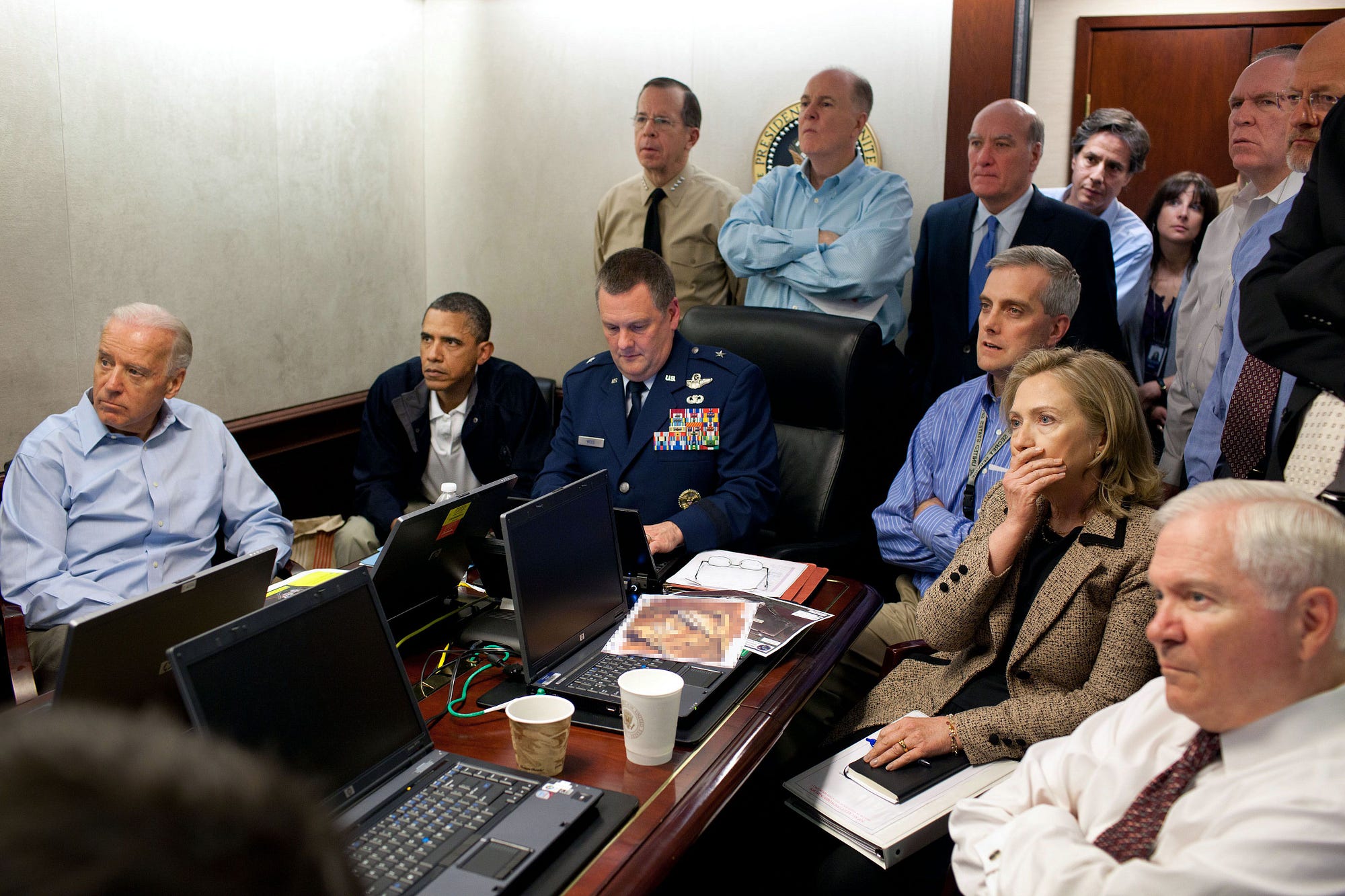
John Brennan, then National Security Advisor to Obama and now CIA Director, told journalists immediately after the raid:
“We were able to monitor in a real-time basis the progress of the operation from its commencement to its time on target to the extraction of the remains and to then the egress off of the target… We were able to monitor the situation in real time and were able to have regular updates and to ensure that we had real-time visibility into the progress of the operation. I’m not going to go into details about what type of visuals we had or what type of feeds that were there, but it was — it gave us the ability to actually track it on an ongoing basis.”
Later, however, then CIA Director Pannetta, who had overall command over the operation with JSOC, contradicted Brennan in an interview on PBS:
“Once those teams went into the compound, I can tell you that there was a time period of almost 20–25 minutes where we really didn’t know just exactly what was going on. We had some observation of the approach there, but we did not have direct flow of information as to the actual conduct of the operation itself as they were going through the compound. There were some very tense moments as we were waiting for information. But finally Adm. [William] McRaven came back and said he had picked up the word ‘Geronimo,’ which was the code word that represented they got bin Laden.”
Whichever of these accounts is true — Brennan’s or Pannetta’s — one of them is a lie. Based on the ongoing failure to resolve the contradictory accounts of what actually happened inside the compound, this would suggest that Pannetta’s account is correct: White House officials, including Pannetta himself — who was the CIA director at the time — did not have direct visuals of the conduct of the operation within the compound (including the actual assassination of bin Laden). They were basing their claims about the details of the operation on what they were told about it by those who executed it.
Yet, it seems, even those who conducted the operation did not seem to have a clear understanding of what it had involved, resulting in contradictory versions of the story, many of which went on to be publicised by Obama administration officials.
Rather than investigating these bizarre discrepancies about one of the most important covert operations in US history, White House officials decided to rush to announce the raid, and to pretend that Obama and other cabinet members had personally witnessed and verified the events of that day.
Yet according to Jack Murphy, a former US Army Senior Weapons Sergeant in a Military Free Fall team in 5th Special Forces Group who served in Afghanistan and Iraq:
“Various accounts of the raid itself have surfaced in recent years, some more accurate than others, none of them close to telling the full account. Contrary to official denials, helmet cam video of the raid does exist.”
If the video feed of the raid itself does exist, why was it not broadcast to White House officials? Did JSOC keep White House officials in the dark about the real-time execution of the operation?
So resolute was JSOC Commander Adm. McRaven’s determination to ensure that public scrutiny of the bin Laden raid, and events leading up it, will remain forever locked down, he ordered all government records relating to the raid to be transferred to the CIA, and deleted from Pentagon files. This guarantees that no information on the raid can ever be gained under Freedom of Information Act requests, and that the real details of the operation will indefinitely remain a closely-guarded intelligence secret.
The Pentagon had even attempted to keep that act secret, by removing mention of it from the final version of an inspector general report published in June 2013. The move allowed the Pentagon to deny repeated FOIA requests from the Associated Press for files about the raid, including copies of the death certificate and autopsy report for bin Laden, as well as the results of DNA tests to identify the body.
So far, there is only one reason to believe the White House’s version of events regarding the bin Laden raid: it is the White House’s version of events.
But this investigation proves decisively that given the fog of lies surrounding bin Laden, and his relationships with the US, Saudi Arabia and Pakistan, this is no reason at all.
Analysis of open sources on the secretive bin Laden raid reveals that the al-Qaeda terror chief was for nearly a decade after 9/11 being protected by Saudi Arabia and Pakistan, two key US allies in the ‘war on terror.’ Despite mounting evidence of the complicity of those governments in 9/11 and other anti-Western terrorist activity, successive US governments have systematically protected the Saudi and Pakistani regimes from exposure.
For Prof. Peter Dale Scott, this US protection of, and unwavering alliance with, al-Qaeda’s chief state-sponsors, is “related to the black hole at the heart of the complex US-Saudi connection…
“… a complex that involves the oil majors like Exxon, the Pentagon’s concern with oil and gas movements from the Persian Gulf and Central Asia, offsetting arms sales, Saudi investments in major US corporations like Citibank and the Carlyle Group (the owners of Booz Allen Hamilton), and above all the ultimate United States dependency on Saudi Arabia, Qatar, and OPEC, for the defense of the petrodollar.”
As precise evidence of Pakistan’s harbouring of Osama bin Laden streamed into the US intelligence community from 2004 onwards, the US response was not to take measures to pressure Pakistan on turning bin Laden over, but instead, as of around 2005, to accelerate Saudi support for bin Laden’s global terror network in a bid to isolate Iran and Syria. When by 2008, the US intelligence community received specific intelligence indicating bin Laden’s presence at the Abbottabad compound, the CIA still failed to act.
By August 2010, when a former ISI officer decided to walk into the US embassy and come clean to US officials who had no idea about bin Laden’s concealment, what was once a highly compartmentalised secret became known to the wider US intelligence community. The White House was forced to do something about bin Laden. But its primary interest, from the get-go, was avoiding a scandal.
Whatever was to be done, the White House needed to ensure that bin Laden would not sing like a canary on his relationships with the West’s own allies. Administration officials also needed to avoid public scrutiny of the US government’s policy of turning a blind eye to mounting intelligence on how bin Laden was harboured, financed and protected by US allies, under a wider US-backed covert operations programme to undermine Iran and Syria.
All those factors no doubt played a key role in the decision to assassinate bin Laden, and manufacture a cover-story that would conceal the damning context of his death from public understanding.
It appears the final decision was not made until late April 2011 — when a British proposal to renew a ‘covenant of security’ with al-Qaeda was rejected by bin Laden. The haste with which the operation was executed perhaps explains the absurd discrepancies in the cover-story.
In Scott’s words: “US security appears to have been hijacked by these deeper forces, in order to protect terrorists who should have been reined in. And the governing media have been complicit in concealing this situation.”
And thus, bin Laden’s execution successfully obscured the wider context of his state-sponsorship, including longstanding US complicity in protecting the governments that protected the al-Qaeda terror chief, before and after 9/11.
Dr Nafeez Ahmed is an investigative journalist, bestselling author and international security scholar. A former Guardian writer, he writes the ‘System Shift’ column for VICE’s Motherboard, and is also a columnist for Middle East Eye.
He is the winner of a 2015 Project Censored Award, known as the ‘Alternative Pulitzer Prize’, for Outstanding Investigative Journalism for his Guardian work, and was selected in the Evening Standard’s ‘Power 1,000’ most globally influential Londoners.
Nafeez has also written for The Independent, Sydney Morning Herald, The Age, The Scotsman, Foreign Policy, The Atlantic, Quartz, Prospect, New Statesman, Le Monde diplomatique, New Internationalist, Counterpunch, Truthout, among others. He is a Visiting Research Fellow at the Faculty of Science and Technology at Anglia Ruskin University.
Nafeez is the author of A User’s Guide to the Crisis of Civilization: And How to Save It (2010), and the scifi thriller novel ZERO POINT, among other books. His work on the root causes and covert operations linked to international terrorism officially contributed to the 9/11 Commission and the 7/7 Coroner’s Inquest.
This exclusive is being released for free in the public interest, and was enabled by crowdfunding. I’d like to thank my amazing community of patrons for their support, which gave me the opportunity to work on this story. If you appreciated it, please support independent, investigative journalism for the global commons via Patreon.com, where you can donate as much or as little as you like.


 RIELPOLITIK