Source – medium.com
– The White House’s story of how US special forces hunted down and assassinated arch terrorist Osama bin Laden in his secret lair in Pakistan is unraveling.
The official narrative of the bin Laden raid is that for over a decade, US intelligence hunted for the terror chief until a surveillance/torture-enabled breakthrough tracked him to a secret compound in Abbottabad, Pakistan. On 1st May 2011, US Navy Seals entered the compound and assassinated him in a furious firefight.
The operation demonstrated how far the US military intelligence community had come since the days of 9/11, proving how its disparate agencies had now developed a tremendous capacity to share and process often obscure intelligence data, to guide precision covert counter-terror missions.
After killing bin Laden, the al-Qaeda leader was buried at sea. When the raid was officially announced, Pakistan, a key US ally in the fight against al-Qaeda, was incensed at the US operation on its own soil.
According to veteran reporter Seymour Hersh’s scoop in the London Review of Books, all this is a convenient fairy-tale. Rather, Pakistan’s Inter Services Intelligence (ISI) captured and detained bin Laden in 2006 with the support of another US ally, Saudi Arabia.
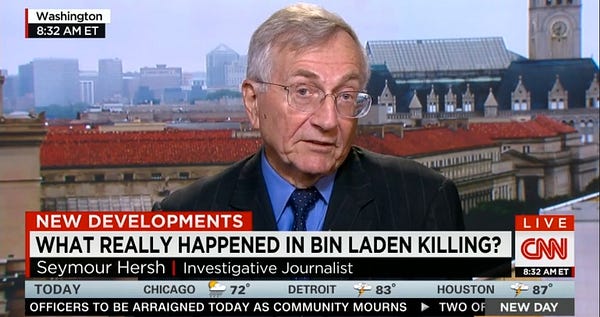
Bin Laden’s location was brought to the CIA’s attention in August 2010, by a former ISI officer and CIA consultant who wanted to claim the reward money. In 2011, the US staged the military intelligence ‘raid’ on bin Laden’s compound with ISI complicity.
There was no firefight. Bin Laden was torn to pieces quickly and easily under rifle-fire, and his remains were thrown out of a helicopter over the Hindu Kush mountains.
Hersh’s account has been rejected by some on the grounds that he relies on unverifiable anonymous sources. This investigation conducts a systematic review of open sources and key journalistic reports relevant to the events leading up to the bin Laden raid.
While much corroboration for Hersh’s reporting is uncovered, elements of his account and the Official History contradict a wider context of critical revelations disclosed by many other pioneering journalists. When that context is taken into account, a far more disturbing picture emerges.
The geopolitical relationship between the US, Saudi Arabia, and Pakistan played a central role in identifying and locating Osama bin Laden far sooner than officially acknowledged — yet nothing was done. The role of a former ISI officer in blowing the whistle on the ISI’s protection of bin Laden in August 2010, brought his concealment out into the open and triggered high-level White House discussions on how to resolve the situation: to kill or not to kill?
Declassified documents, official government reports and intelligence officials confirm that since before 9/11, and continuing for the decade after, the US intelligence community was systematically stymied from apprehending Osama bin Laden due to longstanding relationships with Saudi and Pakistani military intelligence.
Despite specific intelligence available to elements of the US intelligence community on bin Laden’s location in Pakistan, under the protection of US allies, no action was taken to apprehend bin Laden for years. That failure to act coincided with the launch of an anti-Iran US covert operations programme around 2005, pursued in partnership with Saudi Arabia, to finance Islamist Sunni militants including al-Qaeda affiliated groups.
Bin Laden’s assassination in 2011 followed an escalating split within al-Qaeda between the terror chief and his most senior deputy, Ayman al-Zawahiri. Contrary to US claims, bin Laden was positively identified and monitored in the months leading up to the raid, with the assistance of Saudi, Pakistani and Afghan intelligence agencies.
The decision to do so coincided with an extraordinary proposal made to al-Qaeda from British intelligence: to accept a renewed ‘covenant of security’, whereby Western forces would withdraw from Afghanistan and give al-Qaeda a free-hand, on condition that they refrain from targeting British interests.
Bin Laden refused the British offer. Four days later he was assassinated.
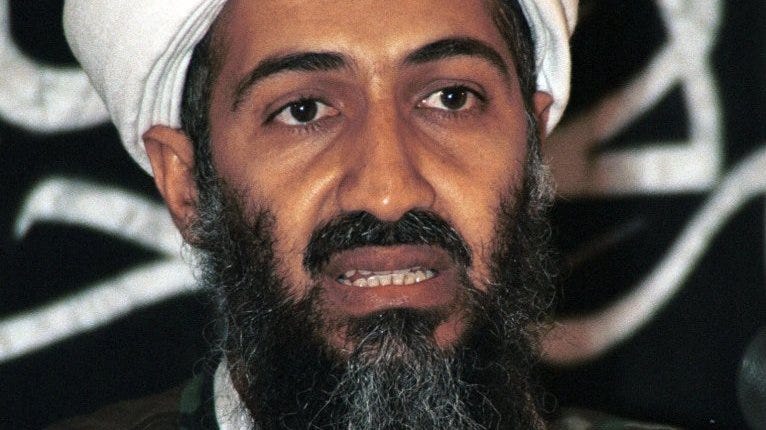
In the wake of his death, and under the leadership of al-Zawahiri, al-Qaeda expanded its operations in many of the countries that had experienced turmoil in the wake of the ‘Arab Spring’ revolutions that year.
Since then — as official Pentagon and other sources confirm — the West’s allies, the Gulf states and Turkey, deliberately sponsored al-Qaeda-affiliated groups in Syria to hijack the revolution and destabilise the Assad regime, a strategy that was covertly supported by the West in 2012, but now openly admitted.
US government officials have scrambled to conceal the facts around the bin Laden raid.
They hope to suppress public recognition that the primary factor in bin Laden’s ability to oversee al-Qaeda until 2011 was US collusion with his state-sponsors, for short-sighted geopolitical purposes.
Corroboration — four years ago
Hersh’s critics, for the most part, have taken issue with his heavy reliance on anonymous sources. As that makes the story supposedly unverifiable, contradictions between Hersh’s narrative and other Known Facts in the ‘war on terror’ Official History mean that Hersh’s narrative must be false.
There is one big problem with this response: Hersh was not the first to break the story.
US national security journalist Dr. Raelynn Hillhouse, a former University of Michigan political scientist and Fulbright scholar who has broken a number of exclusive stories on the privatisation of the US intelligence community, punched holes in the Obama administration’s narrative of the bin Laden raid before Hersh. At that time, her story was blacked out by the US media, but picked up elsewhere such as The Telegraph and New Zealand Herald.
In August 2011, in a series of articles on her national security blog, Dr. Hillhouse cited senior unidentified sources in the US intelligence community who told her that the US government had received notice of bin Laden’s whereabouts from a Pakistani ISI informant, seeking the $25 million State Department reward. Hillhouse’s sources said that “the Saudis were paying off the Pakistani military and intelligence (ISI) to essentially shelter and keep bin Laden under house arrest in Abbottabad.”
What happened then according to Hillhouse’s sources only raises further questions:
“The CIA offered them a deal they couldn’t refuse: they would double what the Saudis were paying them to keep bin Laden if they cooperated with the US. Or they could refuse the deal and live with the consequences: the Saudis would stop paying and there would be the international embarrassment.”
The upshot, Hillhouse reported, is that the ISI and Pakistani military cooperated with the US on the bin Laden raid.
In an interview with The Intercept, Hillhouse confirmed that it seemed clear her sources were different to those who had spoken to Hersh, as they did not consult for US Special Operations Command.
She also said that her own sources had independently confirmed the same facts to her about the disposal of bin Laden’s remains over the Hindu Kush — except that she had decided not to mention this as she couldn’t corroborate it at the time. Hersh’s reporting provided that corroboration.
But the person who first broke this story was neither Hersh, nor Hillhouse. Just days after the raid, former CIA and State Department counter-terrorism official Larry Johnson cited active intelligence sources who told him:
“The US Government learned of bin Laden’s whereabouts last August when a person walked into a US embassy and claimed that Pakistan’s intelligence service (ISI) had bin Laden under control in Abottabad, Pakistan… The claim that we found bin Laden because of a courier and the use of enhanced interrogation is simply a cover story.”
Johnson also confirmed that US intelligence had “learned that key people in Saudi Arabia were sending Pakistan money to keep Osama out of sight and out of trouble.” He also adds some other interesting details, notably that Leon Panetta, then CIA director, ensured that all intelligence leading up to the operation was highly compartmentalised, and fed directly to him.
The charge to assassinate bin Laden was led by Panetta, who wanted to launch the operation as early as February 2011. But it was opposed by Valerie Jarrett, a senior advisor to Obama. The US president “initially sided with Jarrett. The White House spin that Obama had to persuade senior advisors to go after Osama is pure unadulterated bullshit.”
The corroboration of the Hersh account from Johnson and Hillhouse adds weight to its credibility. But other evidence in the public record confirms that it is by far not the whole story: and that the cover-up of events leading to the decision to kill bin Laden occurred precisely to avoid public scrutiny of a wider context of unsavoury geopolitical relationships.
Both the Official History, and the alternate accounts offered by Hersh, Hillhouse and Johnson, agree that the White House did not know of Osama bin Laden’s whereabouts, and that US intelligence was eagerly hunting him down.
But there is already credible evidence in the public record which suggests that while some sections of the US intelligence community were trying to locate bin Laden, other elements of that community had been aware of the likely location of bin Laden’s compound in Abbottabad, Pakistan, for years, and knew that Pakistani military intelligence was protecting him — but did nothing about it.
2004: Musharraf and ISI
In 2004, three months before the release of the 9/11 Commission Report, executive director of the government-appointed Commission, Philip Zelikow, requested a high-level Pakistani to produce a report that would “fill in the gaps about what was happening behind the scenes in Pakistan in the period immediately preceding the terrorist attacks on New York and Washington.”
The report was perhaps the most extensive piece of research on Pakistan’s connections to terrorism, and was based on interviews across the country with sensitive sources including former and active government officials, senior military officers and ISI personnel.

Although the document arrived too late to be included in the final report, like many other sensitive interviews and materials obtained by the Commission, it was not published and remains classified.
Leaks about the content of this classified addendum to the 9/11 Commission Report showed that it had concluded that senior ISI officers had known in advance about the 9/11 attacks, that Osama bin Laden was being protected by Pakistani military intelligence officials, and that President Pervez Musharraf himself had approved for the terror chief to be treated for renal problems repeatedly at a military hospital near Peshawar.
Zelikow, currently a consultant to the Office of the Secretary of Defence, was a former White House National Security Council staffer in the first Bush administration, and a member of President Bush Jnr.’s 2000–2001 transition team, before joining the President’s Foreign Intelligence Advisory Board (PFIAB) until 2003. During his tenure, he played the lead role in re-drafting the Bush administration’s new National Security Strategy. After his directorship of the 9/11 Commission, he was appointed Counselor of the State Department for Secretary of State Condaleeza Rice. More recently, under the Obama administration he served once again on the PFIAB from 2011 to 2013.
The existence of this classified report to the 9/11 Commission demonstrates that the US government had received detailed intelligence confirming the protection of bin Laden by senior Pakistani government, military and intelligence officials as early as 2004.
2006: Abbottabad flagged
Bin Laden’s specific location in Abbottabad had been flagged up in a secret September 2008 US Department of Defence memorandum from Joint Task Force Guantanamo to the Commander, US Southern Command. The memo contained information obtained from Abu Faraj al-Libi, al-Qaeda’s “operational chief” and third in command.
Al-Libi is described by the document as manager of al-Qaeda operations in Iraq, as well as a “senior commander of operations in Pakistan who maintained communication with senior al-Qaeda leadership including UBM [Osama bin Laden].”
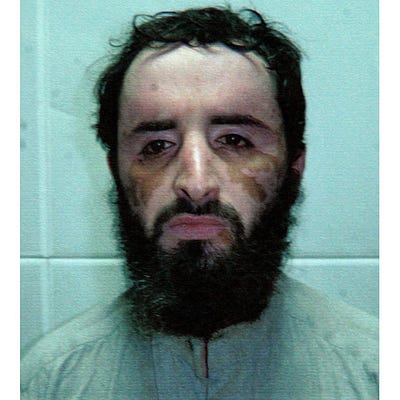
Detained by Pakistani security forces and passed to the CIA in May 2005, the document recorded that he had “provided safe havens for UBL and senior al-Qaeda leader Dr. Ayman al-Zawahiri in 2001 and 2003.”
The document goes on to say that in July 2003 — the year that al-Libi provided a safe haven for Osama bin Laden:
“… detainee [al-Libi] received a letter from UBL’s designated courier, Maulawi Abd al-Khaliq Jan… UBL stated detainee would be the official messenger between UBL and others in Pakistan. In mid-2003, detainee moved his family to Abbottabad, PK [Pakistan] and worked between Abbottabad and Peshawar.”
Thereafter, Abu al-Libi continued to be “the main contact between UBL and Islamic extremists operating inside Pakistan,” and was described as “the communications gatekeeper for UBL and al-Zawahiri.”
According to Gareth Porter, citing Mehsud tribal sources in South Waziristan, Pakistan, al-Libi himself had been tasked with finding the best location for bin Laden and his family to reside, and had “suggested Abbottabad.”
The document thus reveals that al-Libi had moved to Abbottabad precisely to carry out his appointment as bin Laden’s official emissary — a major indicator of bin Laden’s likely presence in Abbottabad. He was simultaneously to act as a communications gatekeeper for al-Zawahiri — a major indicator of al-Zawahiri’s likely presence near bin Laden in Abbottabad.
Al-Libi had been passed onto the CIA by Pakistani security forces in late May 2005, during which he provided detailed information on plans by UK-based cells to attack nightclubs and the “subway” network in London, before being moved to Guantanamo the following year.
CIA records show that the torture and interrogation of al-Libi had exhausted the retrieval of information long before his transfer to Guantanamo in September 2006. After more than a month of continually applied ‘enhanced interrogation techniques,’ the decision was eventually made to cease their use as “CIA officers stated that they had no intelligence to demonstrate that Abu Faraj al-Libi continued to withhold information, and because CIA medical officers expressed concern that additional use of the CIA’s enhanced interrogation techniques ‘may come with unacceptable medical or psychological risks.’”
So the information filed in the 2008 Pentagon report, which collated the basis for recommending al-Libi’s prosecution, had in fact been extracted by the CIA prior to his move to Guantanamo in September 2006.
Therefore, as early as 2006, the CIA had compelling evidence that bin Laden had planned to operate from Abbottabad since 2003, and was communicating with militants in Peshawar and elsewhere through al-Libi.
That document disproves claims by Hersh’s sources that bin Laden moved to Abbottabad in 2006 as a result of his betrayal by locals who handed him over to the ISI for money — rather, the al-Qaeda chief had begun that move three years earlier of his own accord.
2006: NATO spots bin Laden
Hersh’s account asserts that bin Laden had been detained under “house arrest” at the Abbottabad compound since 2006 by the Pakistani ISI as part of a deal with Saudi Arabia, but that the US was not privy to this arrangement.
Yet in the same year, secret US military intelligence documents confirmed not just one, but regular monthly sightings of bin Laden in Pakistan at al-Qaeda planning meetings. A NATO threat report from the International Security Assistance Force (ISAF) in Afghanistan — part of the Afghan War logs published by Wikileaks — stated:
“Reportedly a high-level meeting was held in Quetta, Pakistan, where six suicide bombers were given orders for an operation in northern Afghanistan. Two persons have been given targets in Kunduz, two in Mazar-e-Sharif and the last two are said to come to Faryab… These meetings take place once every month, and there are usually about 20 people present. The place for the meeting alternates between Quetta and villages (NFDG) on the border between Pakistan and Afghanistan… The top four people in these meetings are Mullah Omar [the Taliban leader], Osama bin Laden, Mullah Dadullah and Mullah [Baradar].”
Although the paucity of reports on bin Laden in the Afghan War logs is testament to the terror chief’s largely successful efforts at discretion, they show that as early as 2006, having surmised bin Laden’s location in or near Abbottabad, US intelligence and its assets on the ground had repeatedly sighted bin Laden.
From 2003 to 2009, as the few other intelligence reports in the logs reveal, bin Laden moved around Pakistan routinely, playing a key role in galvanising and planning terrorist operations. He was certainly not under house arrest.
2007: NSA confirms bin Laden in Pakistan
According to top secret National Security Agency (NSA) documents leaked by whistleblower Edward Snowden, US intelligence had confirmed bin Laden’s location in Pakistan in 2007, and been able to track his communication from Pakistan to al-Qaeda operatives in Iraq and Iran:
“SIGINT [signals intelligence] uncovered a message from Usama bin Laden (UBL) intended for al-Qa’ida’s #1 man in Iraq… The message was dated 12 February 2007 and was passed via a communications conduit. The movement of the letter from Pakistan to Iran provided the US intelligence community with unique insights into the communications path used by senior al-Qa’ida leaders in the Federally Administered Tribal Areas (FATA) of Pakistan to communicate with al-Qa’ida leaders in Iraq and Iran.”
The intelligence report on the bin Laden communication — clearly confirming his residence in Pakistan and homing in on the “communications path used by senior al-Qa’ida leaders” — was circulated to the Vice President, the Secretary of the Department of Homeland Security, and the Attorney General, who gave it “rave reviews.”
2008–2009: bin Laden’s “villa” in Abbottabad
After the May 2011 bin Laden raid, renowned ABC News correspondent Christiane Amanpour revealed that precise intelligence on bin Laden’s location had been available much earlier.
She recalled that during a live interview with Bill Maher in early 2008, she had told her host that a senior US intelligence officer informed her of bin Laden’s location in a villa in Pakistan:
“I just talked to somebody very knowledgeable… This woman who is in American intelligence thinks that he’s in a villa — a nice comfortable villa in Pakistan.”
When Maher joked whether the villa was in Cabo, Amanpour replied that bin Laden was “in Pakistan. Not a cave.”
The detail is worth noting — the source appeared to be aware of bin Laden’s location down to the comfort of his building.
India’s external intelligence service had also provided specific information to its US counterparts on bin Laden’s presence in “a cantonment area” — a military or police quarters — “in a highly urbanised area near Islamabad.” The intelligence also included “definite information that his [bin Laden’s] movement was restricted owing to his illness and that it would have been impossible for him to go to an ordinary hospital. We told the Americans that only in a cantonment area could he be looked after by his ISI or other Pakistani benefactors.”
The US did not show much interest in these revelations, according to a senior Indian security source.
The main “cantonment area” nearest to Islamabad is precisely the Pakistani military garrison city of Abbottabad, which is just 75 miles north of the capital. Bin Laden’s compound was 800 odd yards from the Pakistan Military Academy, the equivalent of America’s West Point.
Even Pakistan’s own government believed that Abbottabad served as an al-Qaeda haven. According to an official statement from the Pakistani Foreign Ministry, the ISI had been monitoring bin Laden’s compound in Abbottabad for years, and was providing specific intelligence to the US about the compound since 2009.
Abbottabad generally had been “under sharp focus of intelligence agencies since 2003” due to its role as an al-Qaeda stronghold, according to the Foreign Ministry statement:
“The fact is that this particular location [of bin Laden’s compound] was pointed out by our intelligence quite some time ago to the US intelligence. The intelligence flow indicating some foreigners in the surroundings of Abbottabad continued until mid-April 2011. It is important to highlight that taking advantage of much superior technological assets, CIA exploited the intelligence leads given by us to identify and reach Osama bin Laden.”
Pakistan had purportedly urged the US to identify the occupants of the compound, as the US had “much more sophisticated equipment to evaluate and to assess” what was going on inside.
The CIA and the White House did not deny that this intelligence was shared by Pakistan with its American counterparts.
Other Pakistani ISI sources went further than this official statement in off-the-record interviews with Pakistani Army officer Brigadier General Shaukut Qadir. They told Qadir that they had identified the Abbottabad compound as a likely terrorist base in July 2008, and asked the CIA to conduct surveillance of the building.
In his book, Operation Geronimo (2012), Qadir — who has no ISI affiliation — writes that these ISI sources were unaware of bin Laden’s presence at the compound at the time, but confirmed that the building was being investigated for connections to terrorism. National security journalist Gareth Porter reports:
“Five different junior and mid-level ISI officers told Qadir they understood Pakistan’s Counter Terrorism Wing (CTW) had decided to forward a request to the CIA for surveillance of the Abbottabad compound in July 2008.”
Abbottabad safe-house
Satellite photographs show that bin Laden’s Abbottabad compound was not present in 2001, but appears on images in 2005, confirming it was built that year.
Yet according to the Associated Press, bin Laden’s compound in Abbottabad had been “known” to the US intelligence community “for years” — in what sense it was known, AP does not clarify:
“The walls surrounding the property were as high as 18 feet and topped with barbed wire. Intelligence officials had known about the house for years, but they always suspected that bin Laden would be surrounded by heavily armed security guards. Nobody patrolled the compound in Abbottabad.”
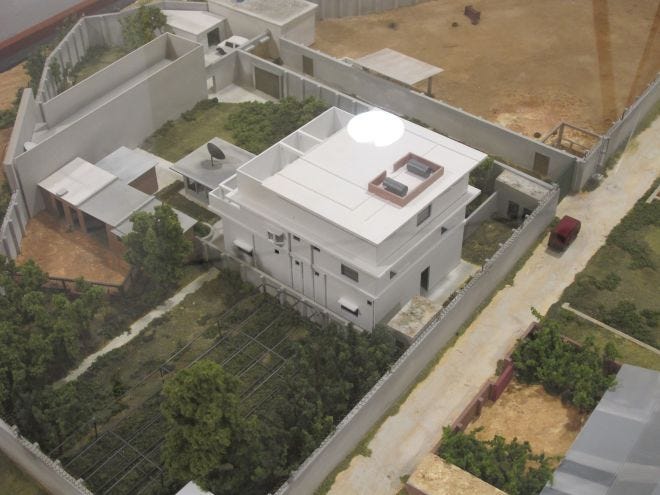
According to one ISI official speaking to the BBC: “Just look at the house — it sticks out like a sore thumb from a mile off. You’ve been to Abbottabad — you know how these small towns are. Everybody knows everything about everybody, and secretive people are routinely investigated, especially by the police.”
In October 2010, a senior NATO official “with access to some of the most sensitive information in the NATO alliance” told CNN that both bin Laden and his deputy Ayman al-Zawahiri were believed by the intelligence community “to be hiding close to each other in houses in northwest Pakistan, but are not together.”
The CNN report explained:
“… al Qaeda’s top leadership is believed to be living in relative comfort, protected by locals and some members of the Pakistani intelligence services, the official said.”
This report suggested that NATO intelligence had pinpointed both bin Laden’s and al-Zawahiri’s location to particular “houses” in northwest Pakistan — but, contrary to the Official History, that NATO was fully aware of their protection by ISI officials. This corroborated the CIA intelligence extracted from al-Libi between 2005 and 2006 on the proximity of bin Laden and al-Zawahiri in Abbottabad, under ISI tutelage.
Therefore, the evidence is overwhelming that by 2008, the US intelligence community was in receipt of detailed, specific information from Indian, Afghan and Pakistani intelligence, locating Osama bin Laden in a military cantonment area in Abbottabad — and pinpointing the location of his compound.
Surveillance
If Hersh’s account is correct, this means that despite all this intelligence pinpointing the Abbottabad compound, the CIA waited several years before establishing a safe-house nearby to conduct extensive surveillance on the premises using telephoto lenses, eavesdropping equipment, infrared imaging, and radars — only after walk-in source exposed bin Laden’s concealment in August 2010.
The CIA also, according to the Official History, deployed dozens of high-altitude stealth drones in Pakistani airspace for months before the raid to capture high-resolution video.
In the context of the evidence of mounting intelligence pinpointing bin Laden in the Abbottabad compound, the Official History raises the following question: Why, in the wake of all the intelligence that bin Laden was in Abbottabad, and despite receiving the request from a Pakistani counter-terrorism agency to investigate the Abbottabad compound in July 2008 — as reported by Brig. Gen. Qadir — did the CIA wait until late 2010 to do so?
It is difficult to avoid the conclusion that the CIA inexplicably sat on intelligence pointing to bin Laden’s presence in the Abbottabad compound for over two years, and perhaps much longer.
When the CIA finally began moving into action, the Official History has it that these efforts were done in such secrecy that even Pakistani intelligence, which was also monitoring the compound, did not know about the CIA surveillance operation (despite having requested it in 2008).
And despite the sophistication of that operation, the Official History has it that the CIA was never able to identify Osama bin Laden. Instead, they managed to catch a glimpse of a man taking regular walks through the compound’s courtyard, who roughly fit bin Laden’s description, and whom intelligence officers dubbed “the pacer.”
Former Canadian Army officer and electronic communications specialist Prof. Sunil Ram, who teaches members of the US Armed Forces at the American Military University in West Virginia, dismissed the idea that such sophisticated surveillance could not have identified bin Laden:
“The public farce around the months of CIA surveillance to determine if it was bin Laden defies logic.”
This is backed-up by Jack Murphy, an eight year US Army Special Operations veteran, in a 2011 article for Sofrep, the news and analysis website run by former US military and special operations officers:
“In reality, Bin Laden was not tracked to the Abbottabad compound by following his courier network. That story was ludicrous when it was first leaked and got even sillier in Bigelow’s movie. Also, the use of stealth aircraft and reports of UAVs conducting electronic jamming operations to obscure the radar signature of the helicopters was also a myth. The truth is that the highest levels of the Pakistani government knew that the [SEAL Team Six’s] Red Squadron assaulters were coming. At least two Pakistani Generals were informed, and this is how Operation Neptune Spear was able to take place so deep into Pakistan without the Pakistani military scrambling fighter jets or troops to the scene.”
Murphy’s confirmation that “at least two Pakistani Generals” had advanced knowledge of the raid, corroborates Hersh’s identification of former Army chief Gen. Ashfaq Kayani and ISI director Gen. Ahmed Shuja Pasha, as the senior Pakistani generals complicit in the raid.
Corroboration for these assertions comes in the form of an ISI source who spoke to Robert Fisk, one of the few journalists who had interviewed bin Laden face-to-face. “I called up one of the [ISI] men I know last night,” Fisk told al-Jazeera, “and put it to him, ‘look, you know, this house was very big, come on, you must have have had some idea.’
“What he said to me was ‘sometimes it’s better to survey people than to attack them.’
“And I think what he meant was that as long as they knew where he [bin Laden] was, it was much better to just watch rather than stage a military operation that may bring about more outrages, terrorism, whatever you like to call it.”
If the ISI had long monitored the compound, and requested the CIA to monitor it too, the idea that they had no idea the CIA was also monitoring it beggars belief.
Indeed, New York Times journalist Carlotta Gall, who has spent over a decade reporting from Afghanistan and Pakistan, cites Pakistani officials who give a completely different picture of bin Laden’s presence at the compound, consistent with the sparse reports already discussed from Wikileaks’ Afghan War logs.
Far from being holed-up to avoid detection, or under house arrest, bin Laden “occasionally traveled to meet aides and fellow militants,” wrote Gall.
One Pakistani security official told her:
“Osama was moving around. You cannot run a movement without contact with people.”
Gall added:
“Bin Laden traveled in plain sight, his convoys always knowingly waved through any security checkpoints.”
She cites a Pakistani Interior Ministry report (conducted therefore by Pakistan’s domestic intelligence agency, Intelligence Bureau), which confirmed in 2009 that bin Laden had met with Qari Saifullah Akhtar, leader of the group Harkat ul-Jihadi al-Islami, the first Pakistan-based jihad network formed during the Afghan war against Soviet occupation. According to the Pakistani intelligence report, the two discussed militant operations against Pakistan.
The meeting, and its monitoring by Pakistani authorities, is significant for several reasons. It shows that Hersh’s narrative that bin Laden was under “house arrest” in Pakistan under the alleged arrangement with the Saudis is incorrect. If that arrangement existed, Pakistani authorities had guaranteed bin Laden’s freedom of movement in the country.
The report also corroborates the sources reviewed above asserting that Pakistan had been closely monitoring the Abbottabad compound for some years. But those sources did not acknowledge the implied kicker of Gall’s piece: the positive identification of Osama bin Laden inside Pakistan by certain government authorities in 2009, and the meticulous surveillance of his movements by Pakistani intelligence.
Fateful triangle: US, Saudi Arabia and Pakistan
The Official History claims that the bin Laden raid was fundamentally and solely a US operation.
Hersh’s account claims that events leading up to the raid revealed that bin Laden was under house arrest by the Pakistani ISI, with Saudi financial support.
But the preceding reports indicate that bin Laden was never under house arrest, that his residency in Abbottabad had been confirmed to US intelligence at least three years before the raid, and that his meetings with militants were being routinely tracked by Pakistani intelligence — which was urging the CIA to investigate the Abbottabad compound as of July 2008.
Yet a further extraordinary report discredits the official and Hersh accounts even further. Both Saudi Arabia and Pakistan, who were harbouring bin Laden in the first place, were also conducting extensive surveillance of bin Laden’s movements in the months leading up to the raid, on behalf of the US.
In other words, in early 2011 the US was working directly with the same Saudi and Pakistani governments that had been protecting bin Laden in Abbottabad.
The report was authored two months before the raid by the late Syed Saleem Shahzad, Pakistan bureau chief for the Hong Kong-based Asia Times and the Italian news agency, Adnkronos. Shahzad was described by the New Yorker as being “known for his exposés of the Pakistani military.”
In his Asia Times article, Shahzad reported that the CIA had launched a series of covert operations in the Hindu Kush mountains of Pakistan and Afghanistan after receiving “strong tip-offs that al-Qaeda leader Osama bin Laden has been criss-crossing the area in the past few weeks for high-profile meetings.” Bin Laden had been tracked to “Kunar and Nuristan for meetings with various militant commanders and al-Qaeda bigwigs.”
US “decision-makers have put a lot of weight on the information on Bin Laden’s movements as it has come from multiple intelligence agencies, in Pakistan, Afghanistan and Saudi Arabia.” Intelligence officials now believe they have “top-grade accounts as they come from the inner circles of militant camps.”
Intelligence officials, Shahzad wrote, were “‘stunned’ by the visibility of Bin Laden’s movements, and their frequency, in a matter of a few weeks in the outlawed terrain of Pakistan and Afghanistan.”
He cited “leaks” from the “inner circle” of the militant group, Hizb-e-Islami Afghanistan (HIA), confirming that weeks earlier, bin Laden had met with the group’s leader, “Gulbuddin Hekmatyar, the legendary Afghan mujahid… in a militant camp in thick jungle on the fringes of Kunar and Bajaur provinces in Afghanistan.”
During the Cold War, Hekmatyar’s HIA received the largest share of military and economic assistance from Saudi Arabia, supervised by the CIA and delivered through the Pakistani ISI.
After the post-9/11 invasion of Afghanistan, HIA was among the many insurgent groups, including the Taliban, that targeted NATO troops and Afghan security forces. But in the years preceding the bin Laden raid, this changed as the US sought ways to end the insurgency and stabilise Afghanistan’s Hamid Karzai regime. Saleem Shahzad noted that:
“Hekmatyar’s representatives of the HIA have been in direct active negotiations with the Americans and have also brokered limited ceasefire agreements with North Atlantic Treaty Organization (NATO) forces in Afghanistan.”
Journalist Edward Girardet, in his book Killing the Cranes: A Reporter’s Journey through Three Decades of War in Afghanistan (2011), reports that in 2009, he was told by former HIA supporters in Kunar, eastern Afghanistan, that “Hekmatyar was operating from the Pakistani frontier tribal agencies of Mohmand and Bajaur with the support of the ISI.”
Thus, throughout this period, bin Laden’s movements appear to have been heavily monitored by the ISI, which even knew precise details about bin Laden’s discussions with Hekmatyar. Shahzad refers to “intelligence sources” that were “privy to the meeting in Bajaur,” where the two terror chiefs discussed a future “grand strategy.”
Corroboration for Shahzad’s report of Osama bin Laden being on the move comes from an interview of a senior official of the Taliban faction, the Haqqani network, by BBC reporter, Syed Shoaib Hasan. The Haqqani network member told the BBC that “he met Bin Laden near the town of Chitral two months ago” — that is, two months before the raid.
Shahzad’s report flies in the face of claims that bin Laden could not be identified by CIA surveillance because he never left his compound, or that he was under perpetual house arrest at the behest of Saudi Arabia and Pakistan. It also corroborates the other reports showing that bin Laden had significant freedom of movement, albeit under the watchful eye of the ISI, and extensive patronage of ISI-sponsored groups, HIA and the Haqqani network.
But more strikingly, Shahzad’s report shows that elements of Pakistani, Saudi, and Afghan intelligence agencies were all involved in monitoring bin Laden’s movements, and were regularly sharing intelligence on bin Laden with the CIA. Clearly, though, this hitherto unacknowledged joint surveillance operation was highly compartmentalised, and known to only certain specialised units in these agencies.
Given that therefore both the Official History and Hersh’s account omit this revelation, the question must be asked as to how long the US was in fact cooperating with Saudi and Pakistani intelligence to monitor bin Laden as he moved back and forth from his base in Abbottabad?
At the end of May 2011, nearly a month after the bin Laden raid, Shahzad was tortured and murdered.
A Human Rights Watch investigation concluded that Shahzad had been assassinated by the Pakistani ISI. Obama administration officials later revealed that classified intelligence proved the culpability of senior ISI officials in directing the operation.
The fact that the US government had such intelligence on the inner high-level workings of the ISI in itself demonstrates the extent of the US intelligence community’s penetration of the Pakistani agency and its secrets.
…Continued in Part 2


 RIELPOLITIK